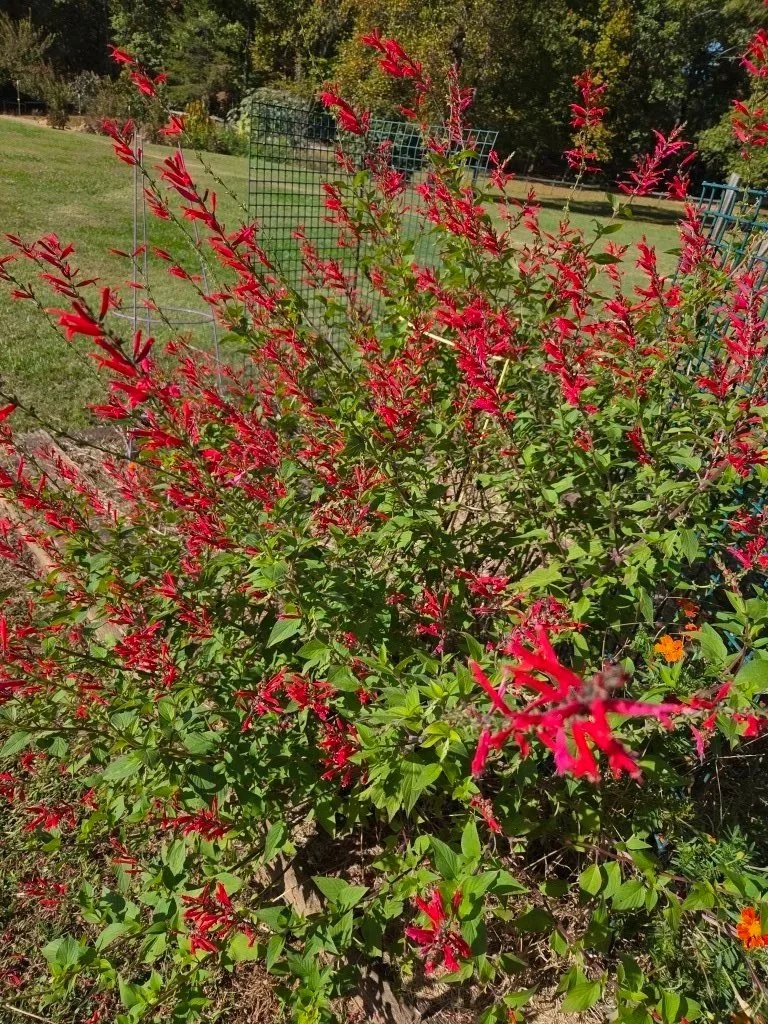
The gardening season in the southeast is winding down, with my area’s anticipated first frost and freeze in the near future. I have removed the spent annuals in my garden beds, mostly Melampodium, Zinnia, and Gomphrena. Others, I leave standing through the winter to support insects and give structure to the garden beds through winter. There are two perennials that have just hit their peak beauty. Both are members of the Salvia genus.
Pinneapple Sage
Pineapple Sage, Salvia elegans (SAL-vee-ah EL-eh-ganz) has bright red flowers that are beautiful in their own right. The bonus comes in their foliage, which has a pronounced scent of pineapple when bruised. In my garden, a single plant is now five feet tall and covered with red flowers. A few weeks ago, it was a favored spot for hummingbirds. The birds have now migrated, and bees have taken over the visitation and pollination duties. All the literature says that Pineapple Sage wants a neutral pH soil in full sun, with regular moisture. Mine has received the proper soil and sun, but I have not irrigated it a single time this year. It is evidently quite drought tolerant once established. I love the plant and hope that it will overwinter for me. It is listed as cold hardy in zones 8-10, but I have never managed to keep one alive through the winter. Sometimes a fall pruning for a marginally-hardy plant can mean death, so I will not cut it back until next spring.
The other salvia that is putting on a show right now is Mexican Bush Sage, Salvia leucantha (SAL-vee-ah lew-KAN-thuh). It is cold hardy in zones 7-10. Like the Pineapple Sage, it is five feet tall. In past years, the tall stems have flopped a bit during late summer, so last year I did an early-summer cutback by half. I also surrounded the individual plants with tall grasses as a leaning post. My Muhlenbergia ‘White Cloud’ *”White Muhly”) failed to impress, so I relocated it to another place in the garden and replaced it with Pennisetum ‘Hameln.’ It will take a year or two for the Pennisetum to settle in, so I look forward to next year’s results.
Bumblebees cover the flowers of the Mexican Bush Sage, The flower spikes initially appear purple, but later in the season become bi-color, with prominent white corollas protruding from their purple bases. There are cultivars that feature all-purple flowers, and I understand that there is a pink form although I have never seen it in a local nursery. Dwarf ‘Santa Barbara’ might be a better choice for smaller gardens. You can hear the bees’ buzz before you notice the flowers. It, too, is quite drought tolerant once established. I have written about this marvelous plant in a past blog. Click HERE for a refresher.
The foliage of Mexican Bush Sage is grayish, which plays nicely with the gray-green of the adjacent ‘Pugster’ butterfly bushes and the nearby Artemisia. Repeating this gray-green shade throughout the garden gives the beds a sense of continuity even though the flowers are of different colors.
Both sages have square stems, which in my experience has been a strong indicator of ease in propagation. If you take late-season cuttings, any that strike roots should be potted and overwintered in a freeze-free area while they gain size and maturity. They can be planted out in their permanent location next spring.
Either of these plants makes a great choice for back-of-the-border options for late season color and pollinator support. Once freezes kill the top growth, the dead stems can be removed, although I prefer to leave mine standing until spring to give the crowns a little extra winter protection.
For additional information on these two plants, please refer to NC State University Plant Toolbox. For Pineapple Sage, https://plants.ces.ncsu.edu/plants/salvia-elegans/ and for Mexican Bush Sage, https://plants.ces.ncsu.edu/plants/salvia-leucantha/