This week I attended a meeting in which all guests were seated outdoors to enjoy the host’s garden and décor. Two of our members were attacked by mosquitoes, while others were unaffected. It made me wonder – Why are mosquitoes drawn to some individuals more that others? Answer: It’s complicated.
Our genetics affect the amount of carboxylic acid and lactic acid we secret and the amount of carbon dioxide (CO2 ) we exhale. All three make us more attractive to mosquitoes. Mosquitoes sense the CO2 you exhale from up to fifty feet away (source: Scientific American). Our blood type has an impact, too. Research from Harvard Health reveals that people with Type O blood are more appealing to mosquitoes than those with Type A or B. Pregnant women, people with fast metabolisms, people with naturally high body temperatures, or larger adults all appeal as a next mosquito meal.
These conditions are beyond our control. One thing that we CAN control is our diet and our alcohol consumption. When I was a regular hiker, I always packed bananas as a trail snack. An experienced backpacker warned me against this. I had always assumed that the scent might attract raccoons or bears, and perhaps it could but consuming a banana can alter your skin’s chemistry enough to make you a target. The effect lasts one to three hours after consumption. Alcohol intake plays into it also. Beer, especially, makes you more “fragrant” to mosquitos seeking a meal.
Even something as innocuous as clothing choices can make us a more detectable target. Mosquitoes are attracted toward green and black fabrics, and less toward white , gray, beige, or pastels.
Females mosquitos are the only ones that bite. They need a blood meal to reproduce. Males do not have the mouthparts required to penetrate human skin. Males feed exclusively on plant nectar. Although they are flying around at all hours, females are most actively seeking a meal at dawn and dusk.
You can take two steps that will help reduce the mosquito count in your outdoor spaces. First, lower the population by removing any standing water. Mosquitoes lay their eggs in water, so if you remove any sources, they will go elsewhere to reproduce. Standing water collects in places that are easy to overlook. Gutters, birdbaths, pockets in fountains, and saucers under container plants. For birdbaths and fountains, you can float a mosquito dunk, a product containing Bacillus thuringiensis (Bt) which releases a protien that destroys mosquito larvae. It is harmless to people and pets. A dunk typically lasts 30 days or so. For small areas like the saucer under a container plant, you can break them in half. There is ongoing discussion in the scientific community as to Bt’s harm to amphibians and other insect larvae.
Step two involves landscaping choices that make your garden less hospitable. Naturally repellent plants are those with heavy scents: rosemary, catmint, sage, onions, lavender, and marigolds.
You can wear long sleeves and long plants to reduce the amount of exposed skin, use a spray-on repellent or essential oils, and avoid being outdoors during peak feeding times. Include some of the above-mentioned plants in containers around your regular outdoor seating areas. Clove oil and cinnamon oil are the most effective natural repellants.
For more information on protecting yourself from mosquito bites, visit this article from the Center for Disease Control.
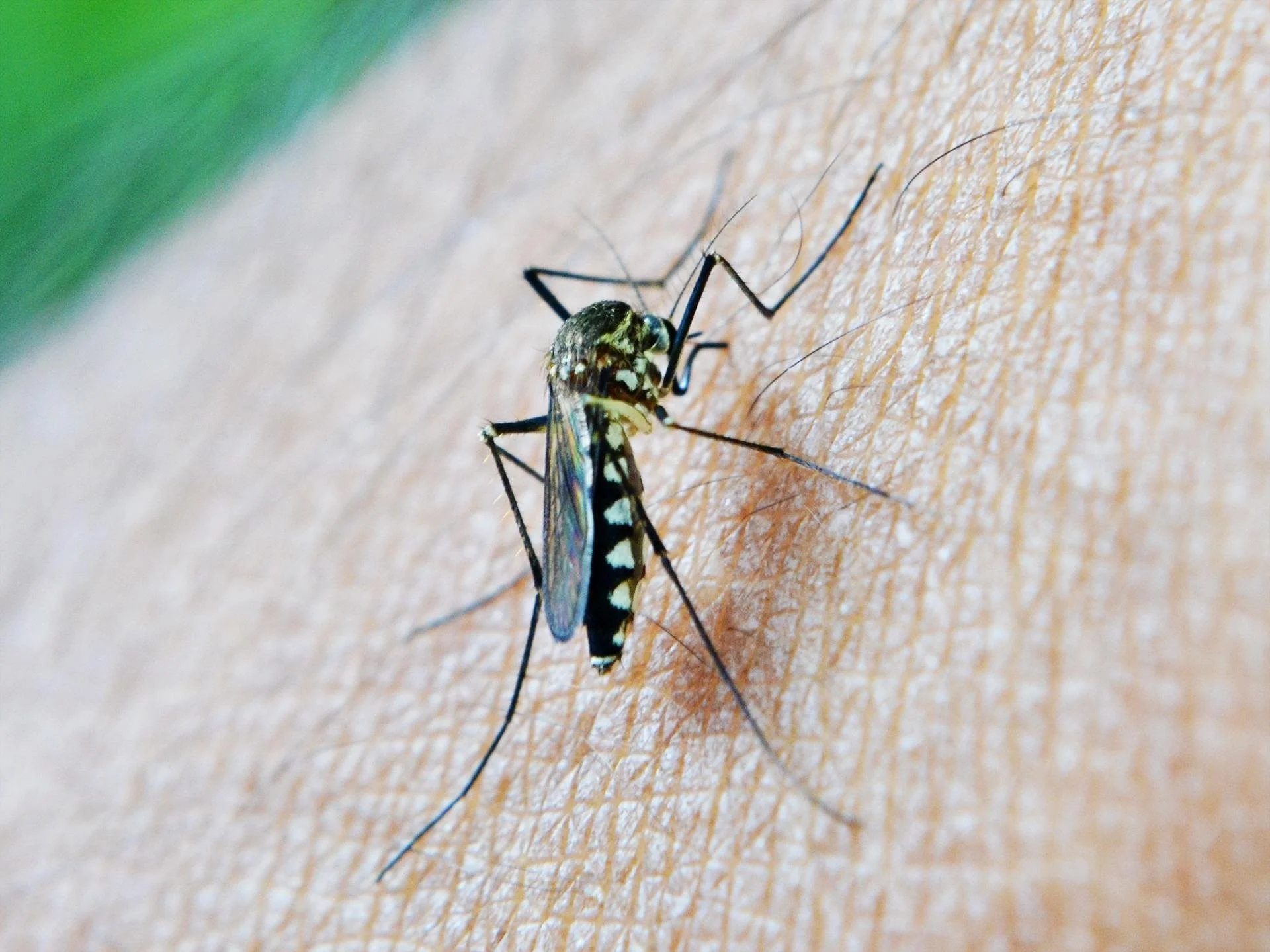
A female mosquito has found a tasty target.