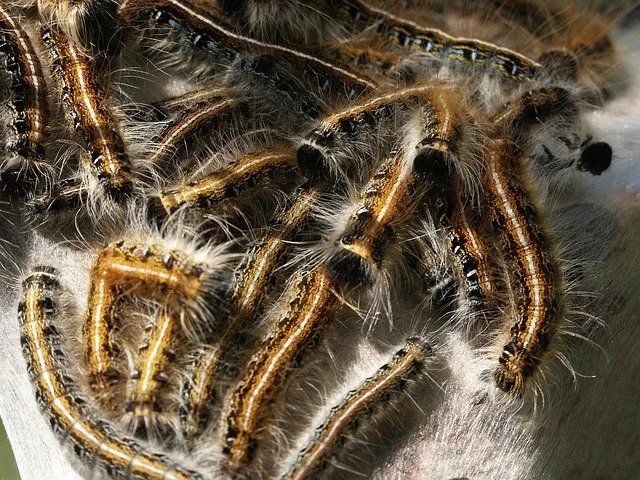
Have you noticed an abundance of webworms in your trees this year? You know – those nests that look like they are constructed of spiderweb threads, but are filled with striped caterpillars. The webs become even more noticeable after the worms have eaten all the leaves on the branches near their nests. I have had a few every year in the past, but this year the webs are more plentiful than ever. I wondered if I should try to control them, or follow my preferred problem solving protocol of ignore-it-and-it-will-go-away.
Clemson University’s Home & Garden Information Center advises us to leave the webs alone because a healthy tree will not be harmed by the small number of leaves they eat. In cases of a weak tree or a prized specimen, a more aggressive measure is to use a pole to tear an opening in the web. This means the worms inside are vulnerable to attack from predators like birds, wasps, and stink bugs. A more aggressive line of attack is the application an insecticide containing Bacillis thuringiensus (Bt) or Spinosad. These are fairly safe for humans and are less toxic to pollinators than other insecticides. Please DO NOT use a lit tiki torch or flame-thrower to set the web on fire. This is a very bad idea.
I learned that there are two separate types of these leaf-eaters, the eastern tent caterpillar and the fall webworm. The identity can be distinguished by the season and the location of the web. Per Clemson, “The eastern tent caterpillar is active in the spring and typically spins a web in the crotch of fruit tree branches, such as wild black cherry and apple trees. The fall webworm becomes active in early summer and spins a web around leaves on the outer branches of trees, and this webbing is seen throughout the growing season. Fall webworms are typically found on pecan, sourwood, persimmon, hickory, sycamore, and fruit trees.”
I follow quite a few Facebook accounts that are related to gardening, ranging from plant identification to insect ID to general folklore, and master gardener groups across the southeast. If you read posts on these sites, it will not take long for you to realize that not everyone who posts responses or identifications is knowledgeable. Respondents would rather take a wild guess than stay silent. As a result, some of the responses are just wrong. This year, I have seen several people identify tree-residing webworms as army worms. They are NOT army worms! Again, thanks to Clemson University for educating me. Army worms are primarily gray in color. They do not build webs in trees. They feed on grass blades, preferring Bermuda and Fescue. They are voracious eaters and can wipe out a lush lawn in a few short hours. Army worms are most unwelcome. Read the Clemson fact sheet here for more information, including identification and treatment.
Feel free to ask questions in these online information groups, especially those sponsored by Master Gardener associations, but check the advice against a science-based resource. When you search a plant question or disease identification, following your question with this phrase site:.edu (site colon dot edu) will return results from university sites only. You can count on their information to be facts, not folklore.
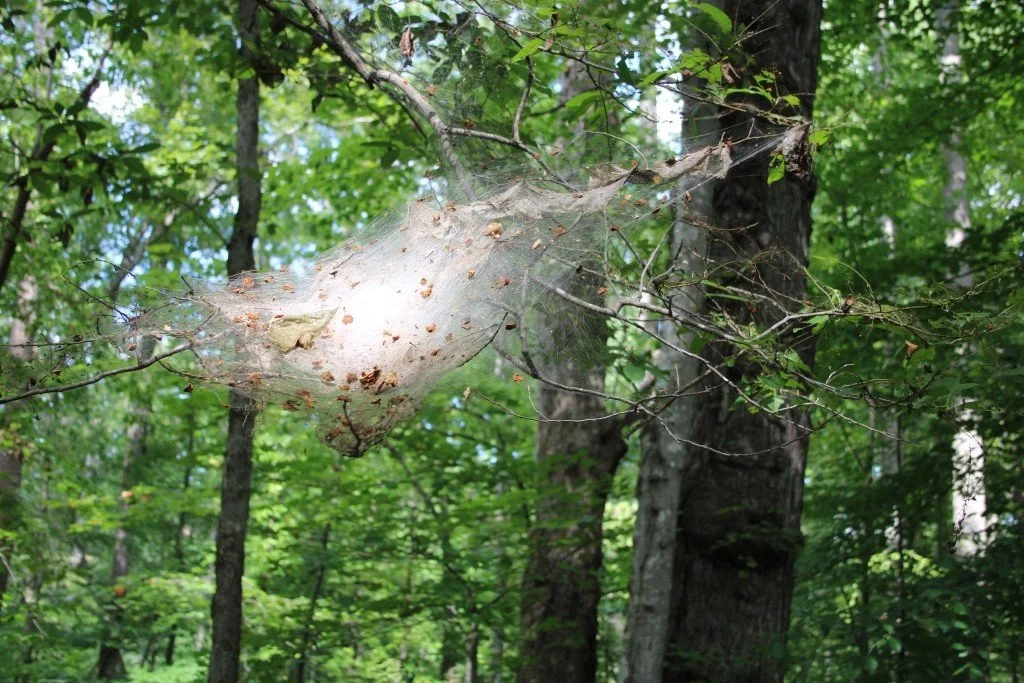
From below, the web looks with white spun sugar (“cotton candy”).
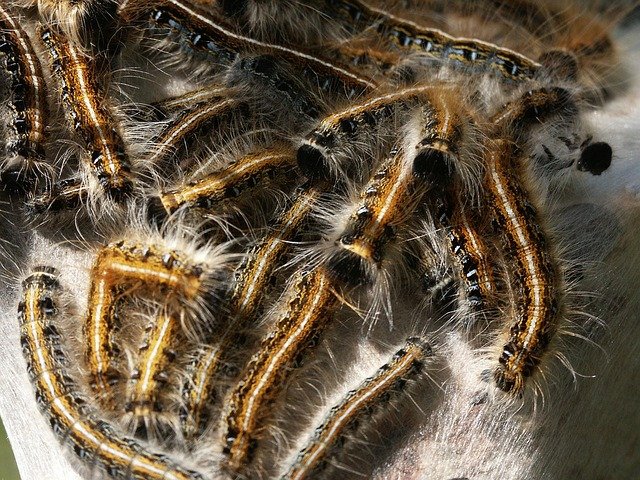
Inside the silk webs are large communities of webworms. Those at the Snoddy place regularly fall into the pool and drown.
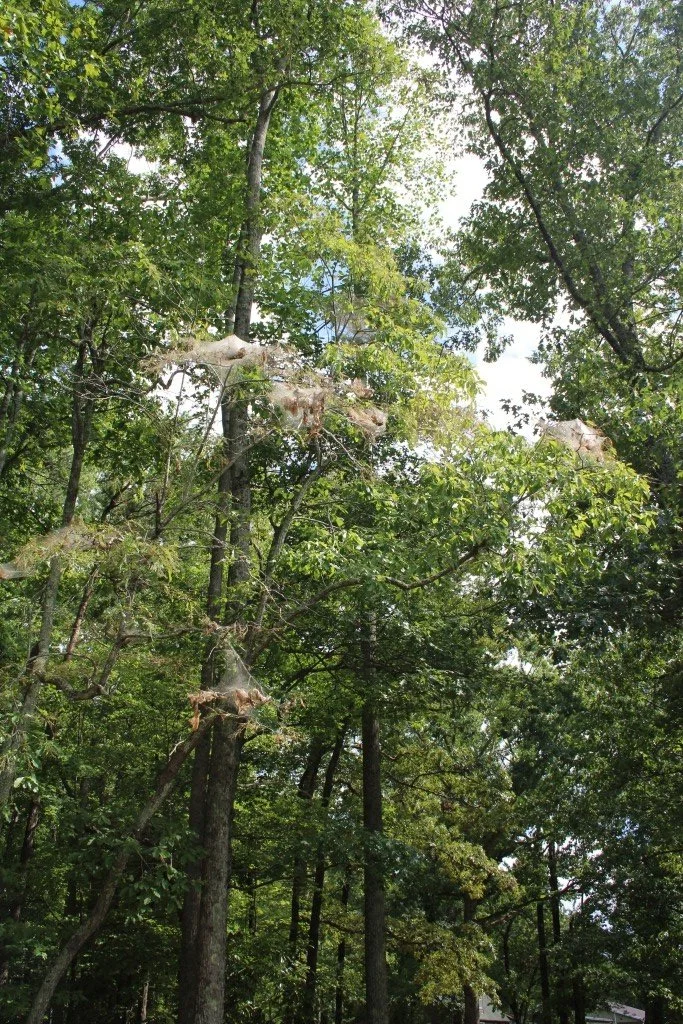
While the webs in this tree are unsightly, the tree will recover without damage.