The National Garden Bureau came into being in 1920. It was the invention of journalist and horticulture educator James H. Burdett. Today the non-profit NGB’s mission is to ““Inspire. Connect. Grow.” They offer factual information on seeds, plants, and gardening products. They are famous for their annual “Year of…” designations that focus our attentions on one annual, perennial, bulb, edible, houseplant, and flowering shrub each year. Member articles throughout the year educate and entertain readers. One such article that I found interesting was, Five Great Plants from the Gardens of the Gods: Plants with Mythical and Historical Uses.
The article featured Acontium napellus (aconite), Morus species (mulberry), Hedera helix (ivy), and Cydonia oblonga (quince). The one that I found most interesting was Narcissus (daffodil). This section is reproduced below, in its entirety. Please follow the highlighted link above to read the whole post. You won’t be sorry. Especially see the legend behind Mulberry. Hint: This is a version of Shakespeare’s Romeo and Juliet that you did not learn in school.
Narcissus (daffodil)
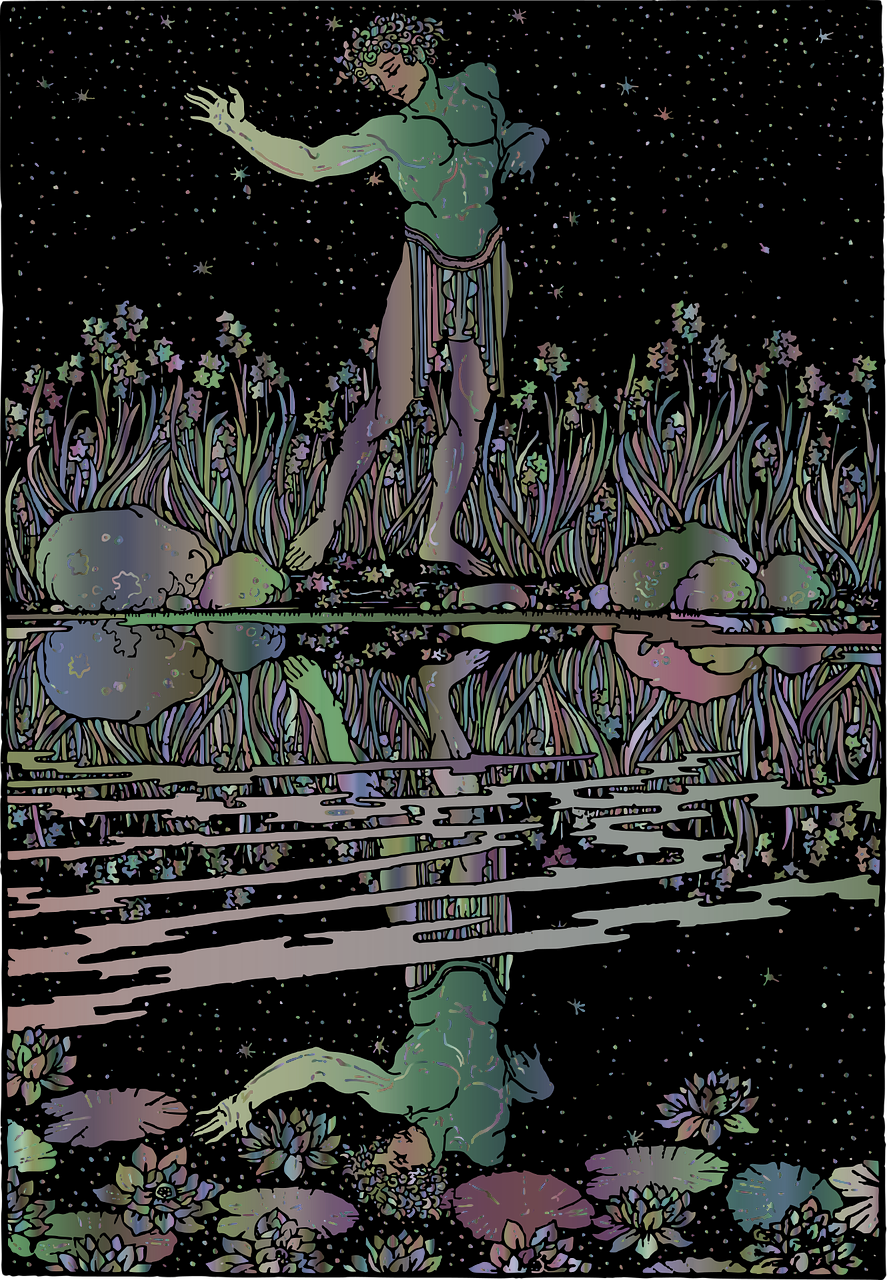
Once upon a time, an arrogant young man named Narcissus fell in love with his own reflection. As he wandered through the woods, he stopped to drink from a pool of water and saw himself reflected in its surface. He was mesmerized. One version of the story says he didn’t realize he was looking at himself and that he stayed there until he wasted away, longing to meet the man in the mirror. Another version says he realized he was looking at himself and understood his love could never be reciprocated, so he killed himself. In both versions, the narcissus flower sprang from his dead body.
A less familiar story tells how Zeus (king of the gods) helped his brother Hades (king of the underworld) kidnap Persephone so Hades could make her his queen. Zeus created a magical narcissus with 100 flowers to captivate Persephone. As she reached to touch it, the ground beneath her opened, and Hades rushed up in his chariot, grabbed Persephone, and carried her beneath the earth.
Persephone’s mother was Demeter, goddess of the harvest. Her father was Zeus, who apparently had no problem organizing his own daughter’s kidnapping. Demeter was devastated when her daughter was taken; she caused all plants to die and allowed no seeds to germinate. Very quickly, Zeus realized that without plants, humans would starve, and without humans, no one would be left to worship the gods. So Zeus commanded Hades to return Persephone, which he did. But first, Hades tricked Persephone into eating a few pomegranate seeds.
For every seed she ate, Persephone was forced to spend a month underground as Hades’s queen. And that’s why we have a growing season and a dormant season. When Persephone is in the underworld, Demeter grieves and allows nothing to grow. When Persephone returns, Demeter rejoices, and the growing season begins again.