I grew up in an era where white chenille bedspreads were popular. They had a frustrating habit of leaving fuzz on everything they touched. It would take an entire adhesive lint roller to freshen black slacks that encountered a chenille coverlet. Chenille Plant, on the other hand, doesn’t shed and doesn’t leave fuzz behind. Its beautiful rose-colored flowers encourage one to stroke them. This is a plant that children enjoy as much as adults.
Chenille plant, Acalypha hispida (ack-ah-LY-fah HIS-pid-ah), is winter hardy only in zones 10-11. While it can be grown as a houseplant, I recently saw a lovely specimen growing outdoors in a container. Both indoors and outside, plants like temperatures of sixty degrees or more. They are fast growers, and can reach heights of four to six feet when grown in the ground. In containers, Chenille Plant behaves more like a well-branched annual and less like a shrub. It prefers part sun, and appreciates a little shade during the late afternoon. It tolerates most soils and most acid levels. Keep plants evenly moist but not overly wet. They are heavy feeders, and like a weekly light dose of liquid fertilizer. Stop the fertilizer during the winter months, to give plants time to enjoy a dormant period.
Plants can be pruned to encourage branching and restrict size. The trimmings are easily propagated into new plants. Plants are either male or female, and only the females produce lovely flowers (male plants flower also, but theirs are not as attractive), so reproduction via cuttings taken from a flowering plant is the way to success. Use caution when pruning. Like other plants in the Euphorbiaceae family, its sap can cause skin irritation.
The flowers are difficult to describe. Think finger-sized and drooping, like a furry red caterpillar. The heart-shaped or oval leaves are bristly, giving rise to one of the common names: Bristly Copperleaf. Other common names are Monkey Tail and Red Hot Cattail. I think Chenille Plant is more descriptive.
Chenille Plant is not prone to diseases or insects, but keep an eye out for spider mites. Keep humidity high to discourage mites.

This Chenille Plant is growing outdoors in an area that receives afternoon shade.
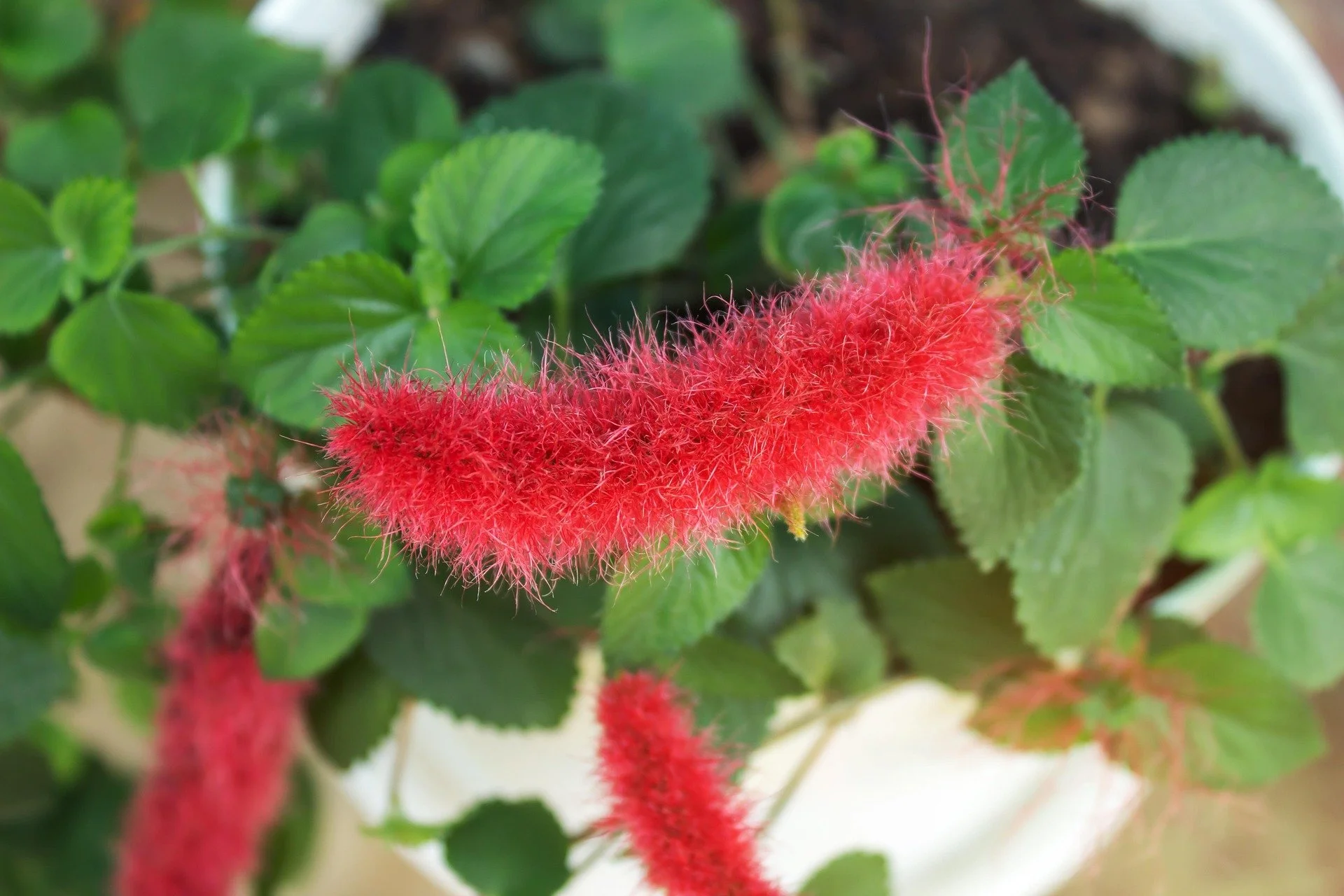
Touchable, furry flowers