Yesterday was one of those “one thing leads to another” kind of days. I recently purchased a fabulous tree, Parrotia subaequalis, commonly called Chinese ironwood. More about that later. I had hoped to plant the ironwood as a replacement for a black cherry tree located near the rear of my home. The cherry has become uglier every year, with leaf spots and broken limbs hanging on by mere threads of bark. It is an eyesore, made worse by its location in clear view of the porch where I relax or entertain.
I asked my husband (nickname: Saint Jim) about the possibility of using the front-end loader on the tractor to pull the cherry out of the ground. He opined that success was doubtful. Next, I asked if we could use the tractor and just push it out of the ground so that roots came up as the trunk went down. Again, he doubted. So imagine my surprise to find the tree gone when I returned from teaching a propagation class. All evidence pointed to the fact that the tree put up quite a fight. It was gone, but the ground and the surrounding grass needed leveling.
First, we raked the entire area to smooth the disturbed soil. Next, we replaced the native rocks that outline the bed where the tree was located. The husband moved on to some of his other chores, while I dug a nice wide hole where the new tree was to go. The soil was soft from the disturbance caused by removing the ugly cherry. I installed the ironwood and mulched around it with my mulch of choice: aged pine bark fines, sometimes sold in bags labeled Soil Conditioner. After I watered the new tree well, I realized that it was too deep in the ground – the root flare was below the surrounding soil level. This is a recipe for slow death, so I lifted the tree and replanted it at the proper depth. I again mulched around it, keeping the mulch a couple of inches aways from the trunk. Perfect!
The only problem was that the freshly mulched area made the rest of this large bed look shabby by comparison. Naturally, I couldn’t leave it that way. I decided to mulch the rest of the bed so that it would have a consistent appearance. But before I could mulch, I needed to remove all the weeds and crabgrass that had thrived under my neglect of this area. So, I weeded and then I mulched the entire bed, and then watered so that everything there was nice and happy. What sounded so simple – plant a 3-gallon tree – took most of the afternoon. I am happy with the result, so I am content.
Let me tell you about the tree. Chinese ironwood has an interesting botanical history. Originally classified as Hamamelis subaequalis, it was later assigned to the genus Shaniodendron before botanists placed it in the genus Parrotia, alongside Persian ironwood (Parrotia persica). Parrotia (par-RO-ti-a) subaequalis was given a separate species in 1992. Both of the Parrotias have lovely, shiny green leaves that flutter in the wind. The flowers are unimpressive, small and red, with no petals. They mature into seed pods that shrink as they dry out. When they burst, seeds are catapulted into the surrounding area.
The tree is at its most impressive in fall. Some leaves of the Persian ironwood are a warm yellow, or have orange or red tints. Chinese ironwood has a strong, bright red fall color that rivals Tupelo (Nyssa sylvatica). A special winter-time bonus of Parrotia is exfoliating bark, with patches of green, tan, and brown.
Chinese ironwood is a small tree, maturing at 20-30 feet, which makes it a great size for smaller home gardens. It wants a full-sun location and is quite heat-tolerant. It is not demanding about soil texture (clay, sand, or loam) and acidity, although the preference appears to be neutral-to-acidic. While new trees should be irrigated in dry periods, established trees are drought tolerant. Ideal soil is well-drained, They will not survive in boggy areas.
Because of its modest size and heat tolerance, Chinese ironwood makes a good choice for parking lot islands or difficult home scenarios. Trees can be multi-trunked like a large shrub, or trained to be single trunked. If you desire the single-trunk appearance, purchase a young tree and prune small limbs away near the ground, working up the trunk as the tree gains height. Parrotia normally grows at a moderate rate, but can be encouraged with supplemental irrigation and judicious fertilization. It is a fabulous tree, worth searching out. And although planting mine turned into considerably more work than anticipated, I think it will be worth every minute.
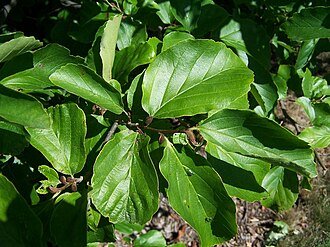
Parrotia has shiny leaves in summer. Photo by Bruce Marlin, CC by SA-3.0
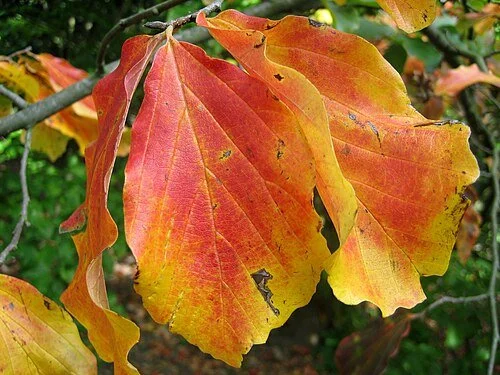
Persian Parrotia leaves. Chinese Parrotia leaves turn a deep, clear red. Photo by Lynk media - CC BY-SA 3.0
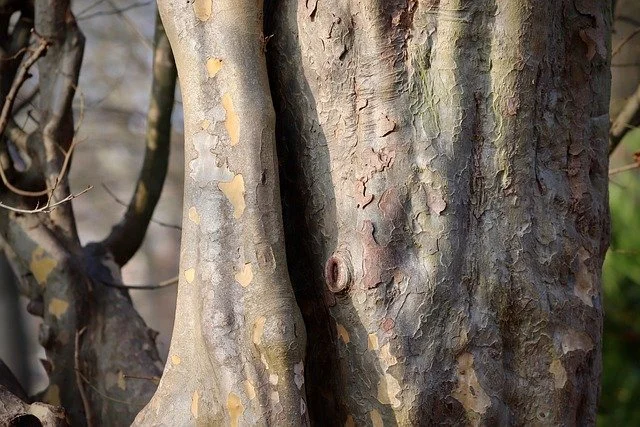
The patchy, sinewy appearance of a Parrotia trunk stands out in winter.