Winter Garden

Winter Weather Woes in the Garden

Like many others across the Southeast, my garden is wrapped in ice today. We are experiencing record-breaking cold temperatures, with power outages and frozen water pipes topping the list of concerns. My garden has taken a beating, and I expect to lose some plants that were marginally hardy for my Zone 8a conditions. Only time will tell.

Ice storms cause more damage to gardens than snowstorms. Light snow accumulation can usually be dislodged with a broom or pole and a gentle jostle to the limbs of broadleaf trees such as Southern Magnolia or conifers like my prized DeGroots Spire Arborvitae. Ice, on the other hand, adheres stubbornly to leaves and branches. Shaking shrubs or trees to remove it often causes more breakage than the ice itself. Waiting for warmer temperatures and sunlight to do the work is often the safest option.

For future winter weather events, there are a few steps you can take to help your plants survive:

  • Protect root zones. Before frigid temperatures arrive, cover the root zones with chopped leaves or coarse mulch. This should be temporary. Remove the material once temperatures moderate to prevent crown rot caused by excess moisture.

  • Shield vulnerable plants. Tent shrubs or small trees with shade cloth or old sheets to reduce ice accumulation. Use T-posts or upside-down buckets to prop the fabric above the plant so the weight of ice does not break limbs. If fabric is unavailable, evergreen boughs can also provide protection. This is a good use for an old Christmas tree, if you still have one. For especially tender plants, place a tomato cage around them and wrap the outside with cloth or plastic.

  • Move container plants. When severe cold is predicted, relocate dormant container plants to an unheated garage or storage building. The goal is to keep them cold enough to remain dormant, not warm enough to trigger spring growth. The same applies to shrubs or trees still in nursery pots awaiting planting. (I’m guilty here. I intended to plant my Pittosporums and Grey Owl Juniper weeks ago, but that didn’t happen.)

  • Manage snow carefully. If snow is the issue, gently remove it from branches with a light shake or a leaf blower, but allow it to remain around the base of plants for insulation. It may seem counterintuitive, but snow maintains a temperature of about 32°F, while surrounding air can be much colder.

  • Support conifers. Ice can cause conifers to spraddle and break. Shorter specimens can be loosely wrapped with rope to hold their form, but be sure to remove the rope as soon as the ice melts to avoid damaging the plant.

  • Do not water plants when soil temperatures are below freezing.

Avoid walking across ice-covered sod. Even dormant lawns may show breakage or footsteps when they green up in the spring. Give special TLC to anything recently planted in your garden. Even if listed as hardy in your zone, those plants may not be well-established. Of course, the “too little, too late” advice is to select plants for your particular hardiness zone.

It make take weeks for damage to reveal itself among your garden plants. Please be patient and wait for the arrival of spring. Prune only to remove broken limbs.
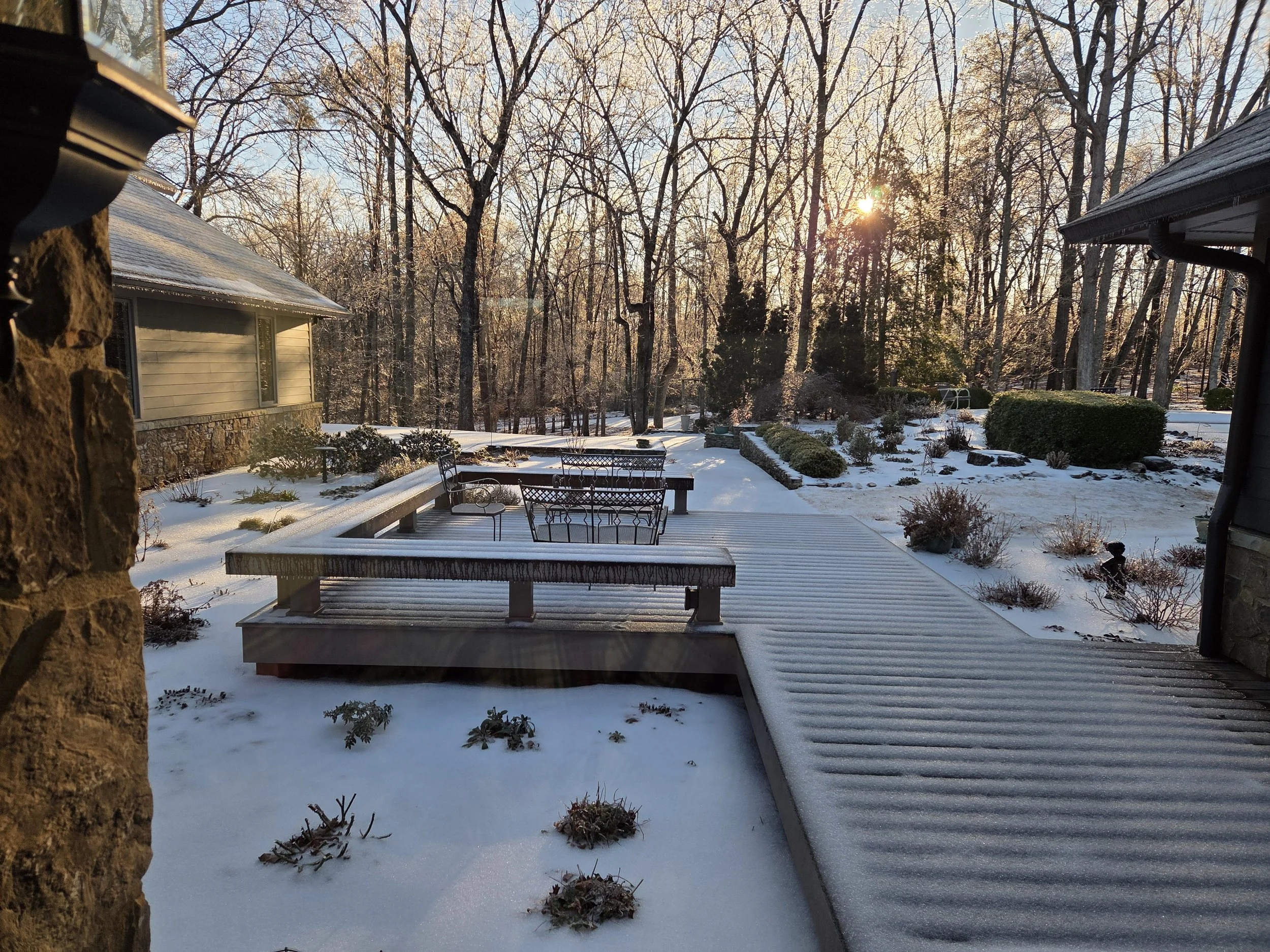
Wood deck frosted with light snow and ice

Early in the storm, we had a light dusting of snow and I breathed a premature sigh of relief. Later in the day, freezing rain turned this same view outside my front door into an ice sculpture.

Expanding The Gardeners' Vocabulary

I added a new word to my gardening vocabulary this week: thermotropism. In simple words, this is a plant’s reaction to temperature changes. Rhododendron exhibits one of the most obvious reactions to cold weather. When the weather turns frigid, Rhododendron leaves curl inward. It may look like the plant is suffering from drought, but instead it is reducing the surface area exposed to cold to keep internal moisture from evaporating.

While I was researching thermotropism, I discovered an entire family of -isms in the horticulture world. Phototropism is when a plant moves in reaction to light (sun). I’m sure you have seen in your own gardens how sunflowers turn their heads to the east to catch the morning sun, then slowly turn toward the west as afternoon arrives. Foxgloves and daffodils do the same.

Thigmotropism is when a plant encounters a solid surface and reacts to it – like a morning glory curling around a trellis. A reaction to the presence of chemicals is chemotropism. Think of the way roots move towards areas of higher soil fertility. A plant’s reaction to gravity is called geotropism or gravitropism. Movement in search of water is hydrotropism. And some plants react to touch. The tickle of insect legs will cause a Venus Flytrap to snap closed around its next meal.

The southeast is predicted to experience a serious winter storm later this week, the first measurable snowfall in my town since 2022. It might be an insignificant event in the opinion of my friends that moved from Michigan, Minneapolis, and South Dakota. For this SC native, anything more than an inch of snowfall can rightfully be called a blizzard. So, I’m going to practice thermotropism, and wrap myself into a down duvet like a human taco. Friends, stay safe and warm!

Thirsty? No - COLD! This Rhododendron has curled its leaves as self-protection..

Photo By Nicholas A. Tonelli - Flickr: Nature's Thermometers, CC BY 2.0, https://commons.wikimedia.org/w/index.php?curid=24186333

Winter Jasmine, The Earliest Flowers

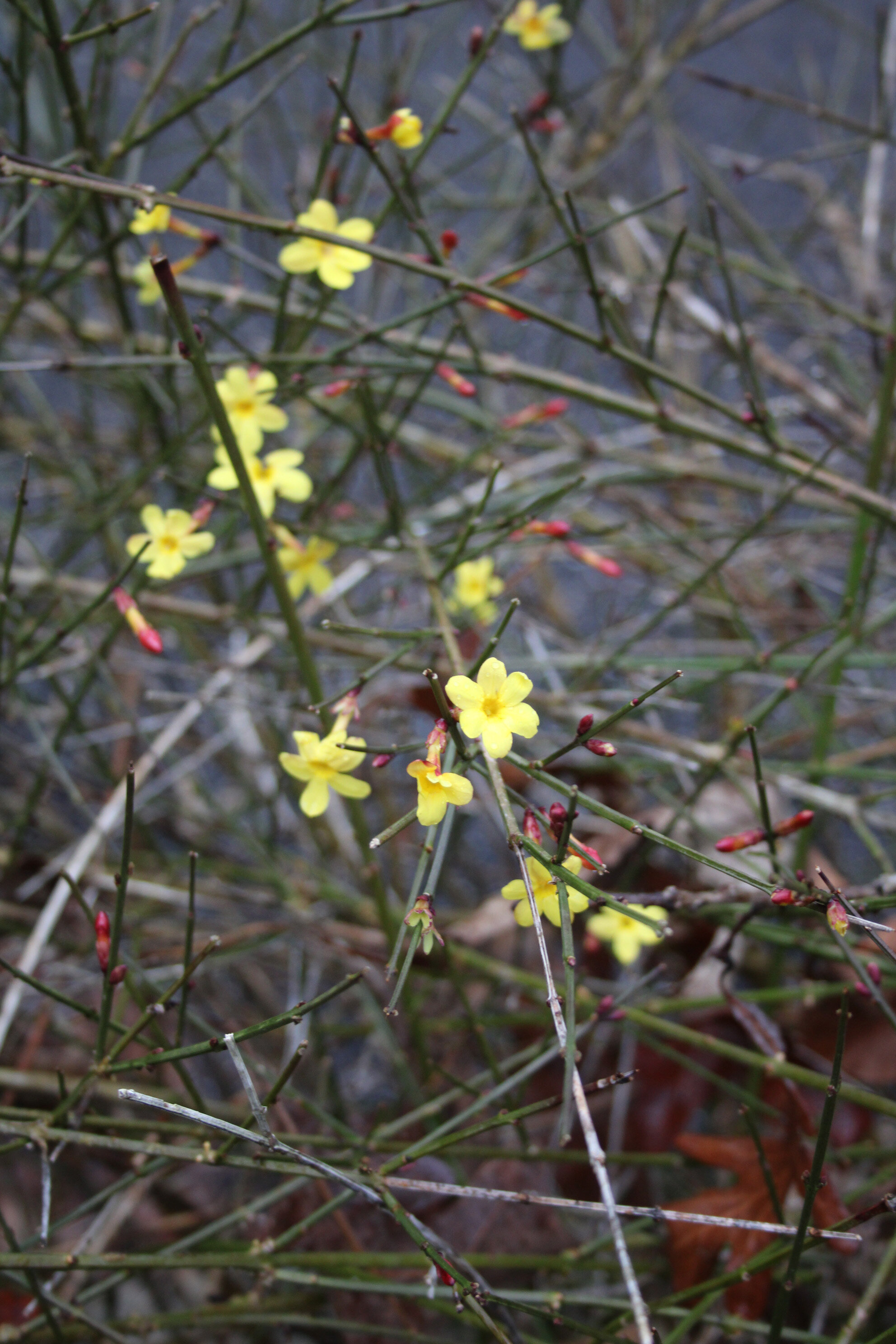
Tubular yellow flowers are erupting on leafless shrubs here in the Carolinas’ piedmont. Winter Jasmine (Jasminum nudiflorum, pronounced JAZ-men-um noo-duh-FLORE-um) blooms early, about the same time as Crocus. The 6-petal unscented flowers are similar in color and shape to Forsythia, but are smaller and fewer. Flowers appear before leaves, and open first at the bottoms of stems, progressing to the tips. The shrub’s weeping structure is similar to Forsythia, but stems are smaller in diameter and young stems have a greenish tint, even when dormant.

Red exterior of unopened Winter Jasmine buds.

Red exterior of unopened Winter Jasmine buds.

Plants reach five feet in height. Like Forsythia, Winter Jasmine will spread aggressively unless controlled. Any stems that touch ground will take root. It flowers best in full sun but will tolerate shade, poor soil, and drought. Left alone, plants take on an unkept, thicket-like appearance after a few years. Remedy this with severe pruning as soon as the flowering season ends. I inherited an overgrown hedge of these plants when we bought a new home. They have encroached into the territory of a nearby row of boxwoods that I want to preserve, so in March I’ll cut the entire hedge to within a few inches of the soil and use a sharp spade to sever and remove the roots outside the target range.

Winter Jasmine stems are squarish in cross section, with four definite angles, while Forsythias are round. Tiny (less than an inch) compound leaves appear opposite on stems, which allows the gardener to distinguish it from Jasminum floridum, a visually similar plant with alternate leaves and the same messy haystack of stems.

Winter Jasmine is an excellent groundcover plant for slopes that would be difficult to mow. Its arching stems look like a waterfall cascading over walls . It is rarely damaged by deer, disease, or insects. It is hardy in zones 6 through 10

A hedge of Winter Jasmine, planted  on a steep bank above a business parking lot. Perfect for this location.

A hedge of Winter Jasmine, planted on a steep bank above a business parking lot. Perfect for this location.

The thicket-like growth of Winter Jasmine is evident here. The gray stems are dead and should be pruned out. Live stems are green.

The thicket-like growth of Winter Jasmine is evident here. The gray stems are dead and should be pruned out. Live stems are green.

Heavenly Hellebores

Hellebores, or Lenten Roses, are one of the few plants that bloom in winter. They are happiest when planted under deciduous trees, so that they receive full sun in winter (when no leaves are on trees) and are shaded during the heat of summer.

Keys to success:  Don't plant too deeply, or they will die.  Don’t allow mulch or leaves to collect over the crown, or they may rot.  Water them only until established. Wet soil is deadly. No regular irrigation, please.

Hellebores reseed readily, but typically do not come true. What does that mean, exactly? Seeds from a plant with purple blooms may grow into another plant with purple blooms. But it is equally likely that the new plant will have pink or green blooms. I consider this a bonus. (If you come from a software development background, consider this variability an “undocumented feature.”) And they all have different freckles and whiskers that give them individuality.

Use this Thrifty Gardener trick: Put a few plants at the top-most part of a sloping garden bed. Nature and gravity will work together to sow seeds down the slope. In just a few years, you will have a full bed.

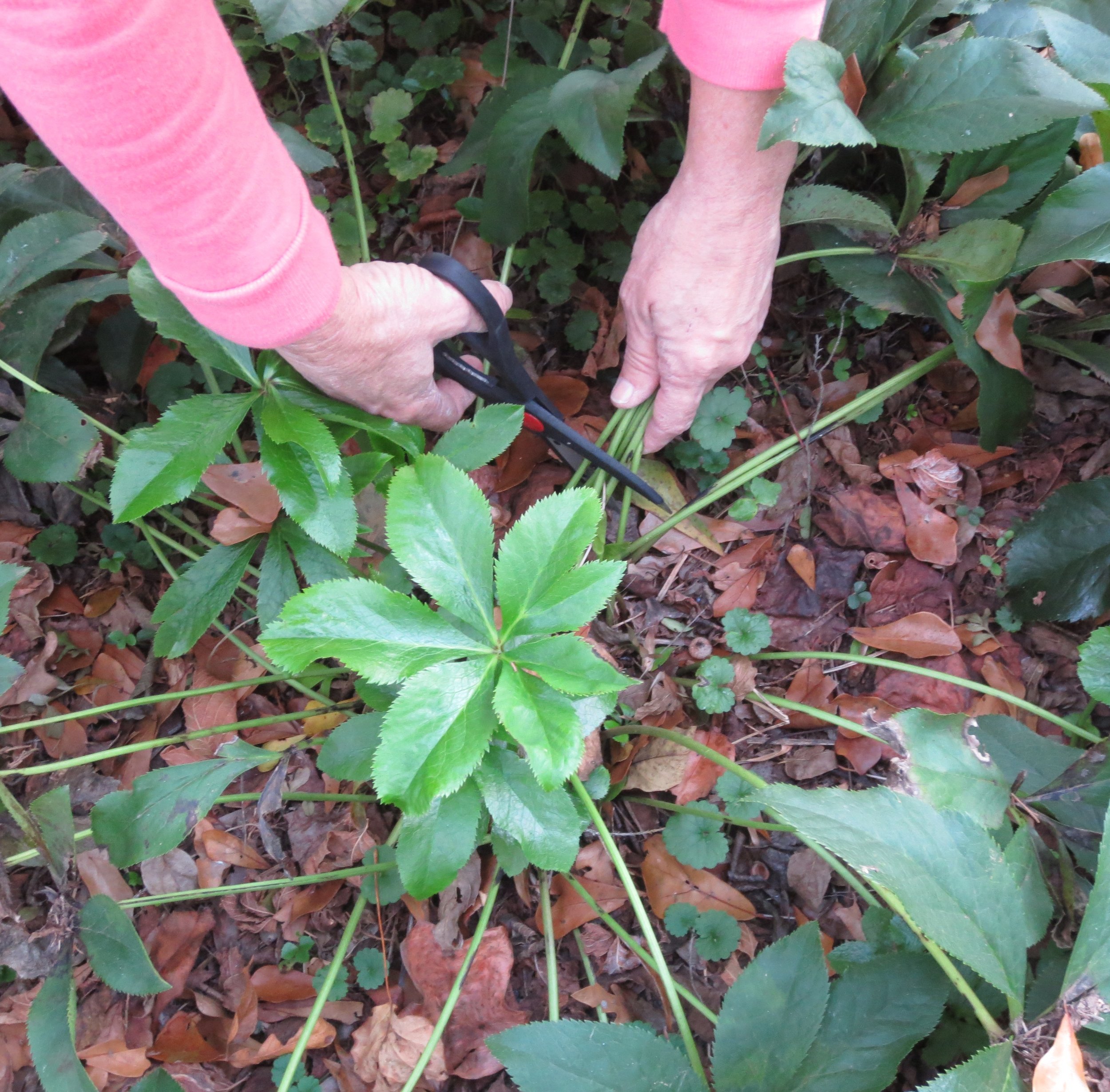
To make your plants look their absolute best, keep an eye out for the emergence of new growth. When you see fresh green leaves coming from the crown, grab your pruners and remove all the old, ratty foliage. See the before and after photos, below.

Remove Tattered Leaves.JPG
After Cleanup.JPG