Mary's Helpful Hints

Pre-Winter Propagation Chores

It is Thanksgiving week, and I am concentrating on hosting family and friends rather than researching cool plants. Instead of my normal format, I want to share a few photos of my pre-winter tasks. Other than a single cold snap in October, this year’s autumn has been unusually warm. This means that I had extended time to take a few cuttings for rooting in the greenhouse, as a head start on next gardening season.

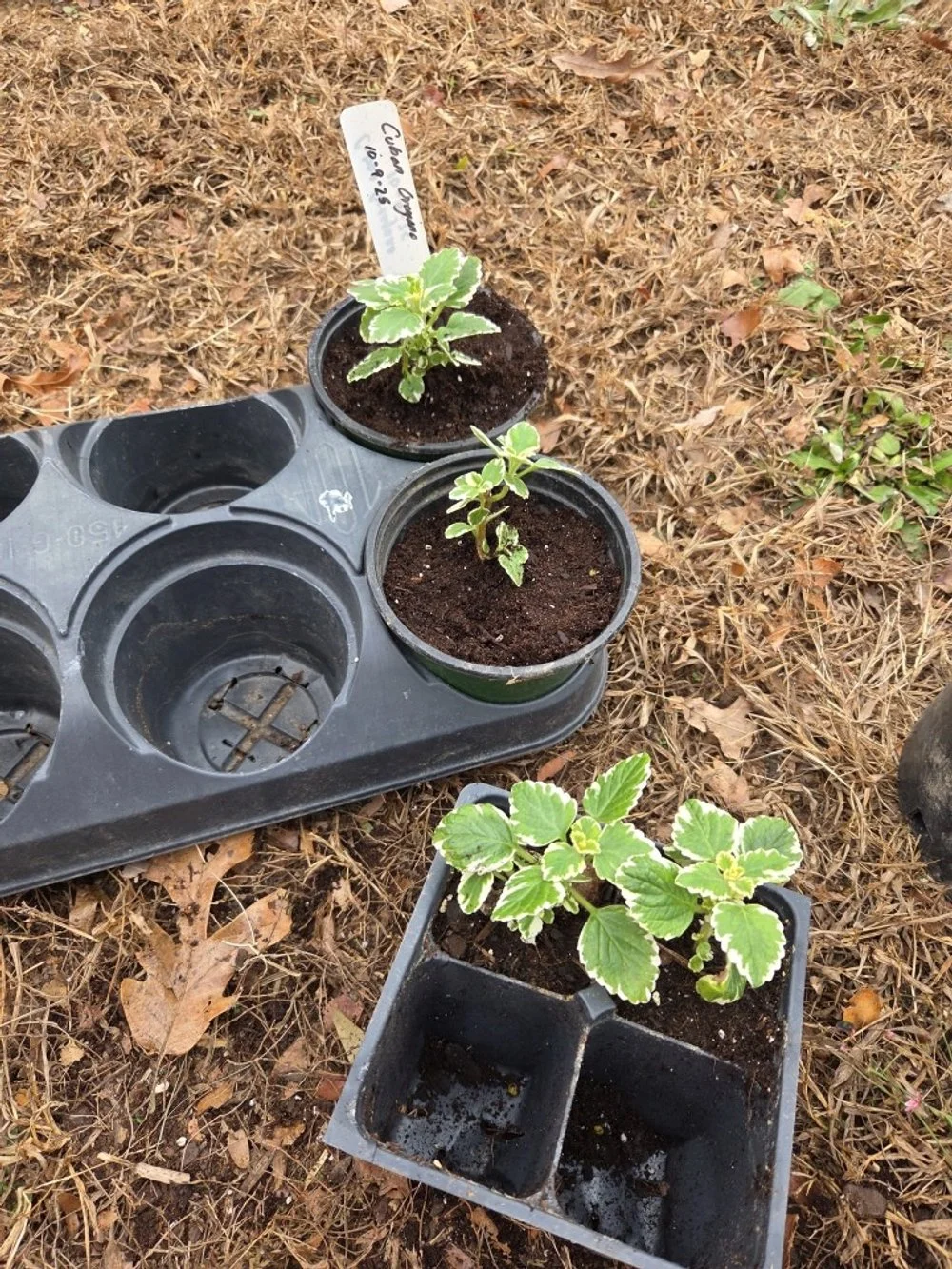
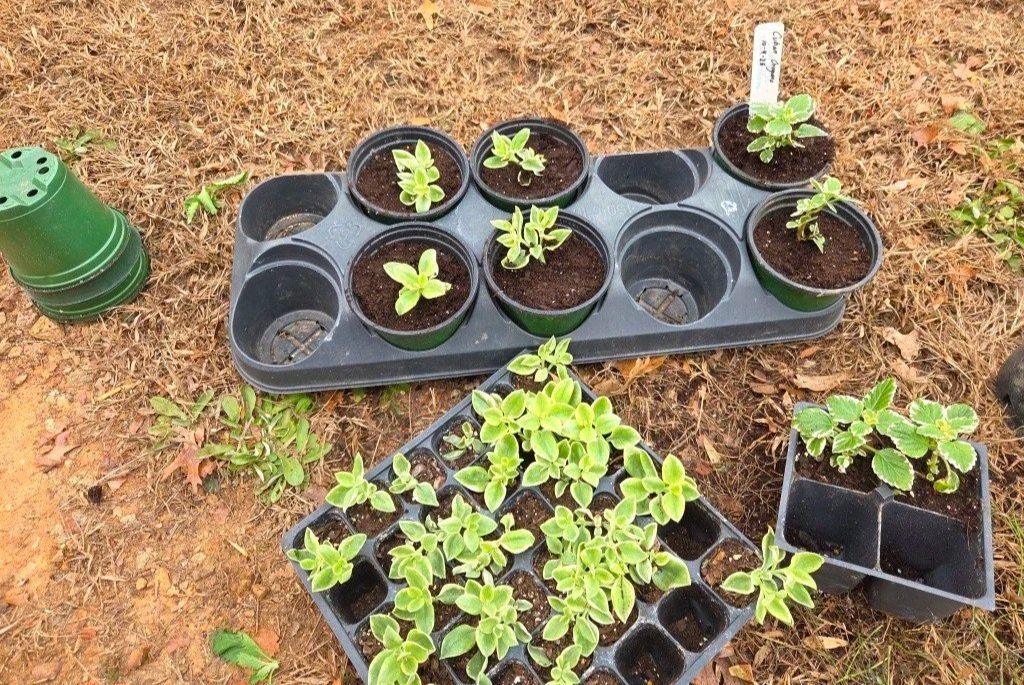
A green-and-white container combination seems fresh and cool in the hottest part of the summer. I like to combine Cuban Oregano with variegated ivy and Diamond Frost Euphorbia. The Cuban Oregano (Plectranthus variegata) shown here was a gift from my friend Ann in 2009. The plant is not cold-hardy, so I have overwintered a few cuttings every year since then. It is a wonderful memory of our friendship. I take more cuttings than I need as insurance against rooting failure, so I have extras to share. Six weeks ago, I started four branch tip cuttings to take advantage of apical dominance – plants like to grow from their tips -- in a recycled, sanitized four-pack. They rooted well, so graduated this week to four-inch containers.

Cuban Oregano (Plectranthus variegata) is moving from a 4-pack to a 4-inch container.

I adore the succulent groundcover Mezoo. It has gone by several genus names, including Aptenia, Doreanthus, and Mesembryanthemum. I do not know which one of these is correct, so I rely on the common name in my labeling. Mezoo roots readily and grows fast, so I stuck my cuttings in two-inch plugs. Most have rooted and are ready to graduate to four-inch pots. In late February, they will need to move up again, to one-gallon containers.
About that labeling: the plant labels you see here are sections of an old window blind. A single damaged vinyl blind (cat owners, IYKYK) can be recycled into a lot of plant labels. The slats are flexible enough to cut to the preferred length with kitchen shears, and strong enough to last. They don’t rot or rust. For plants that will go into the ground without their labels, I use a Sharpie Extreme marker on the blind. The Extreme will withstand UV rays and frequent watering without fading. For transplants that will have their identifying label planted along with the plant itself, I use weather-resistant tape on a Brother P-Touch Label Maker. Some of these have lasted more than five years for me. Sadly, a few have outlived the plants they identified. 

Small green and white plants in plug trays and 4-inch pots

Lovely, heat-tolerant, succulent groundcover Mezoo is moving from plugs to 4-inch pots. It will share a tray with Cuban Oregano, since they both prefer drier conditions in the greenhouse.

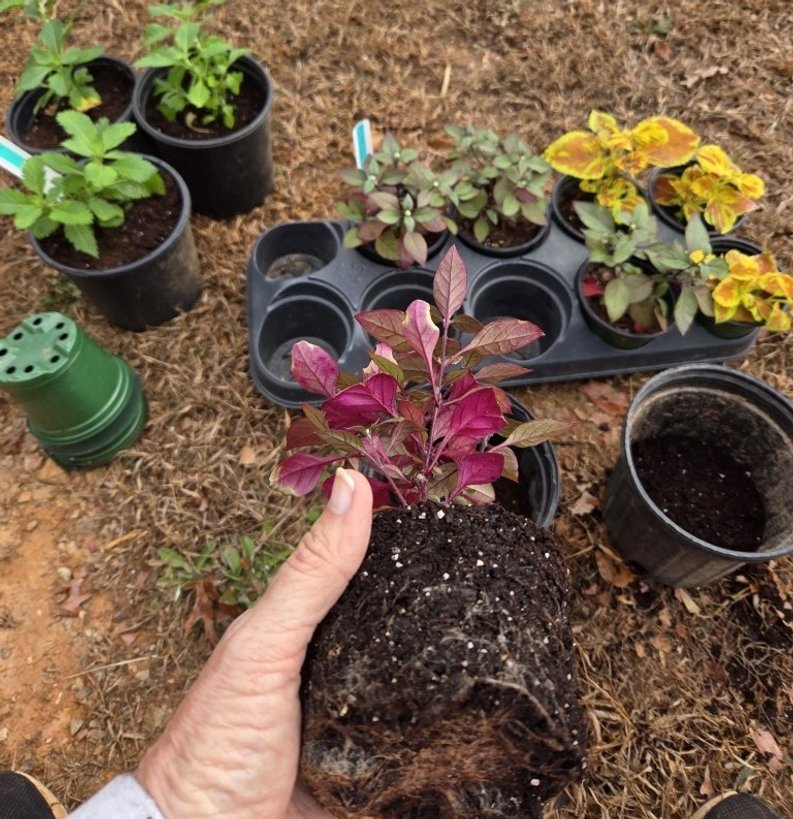
I took a few cuttings of favorite annuals, Alternanthera ‘Purple Prince’ and Coleus ‘Freckles.’ Here, you see that I have removed the Alternanthera from its four-inch container to confirm that it has enough roots to move up to a one-gallon size. I do not know the science behind it, but plants prefer to move into slightly larger containers. If a two-inch plug goes directly into a three-gallon container (I exaggerate, but you get the point), it will languish and fail. That same rooted two-inch plug will move successfully to a four-inch container. Once that four-inch container has roots showing around the bottom and sides, it can be bumped up to the next size, and then again once that pot shows roots around its outside perimeter. To ensure the good health of a plant, move it to the next larger size before it gets rootbound, meaning that the container is overfilled or choked with roots. Even though I am using round pots in these photos, I far prefer the square pots. There seems to be less root girdling with squares than with rounds. Rounds have the advantage of using less potting soil.  

Hand holding plant showing roots

Checking that the cutting has rooted well enough to move to the next size container.

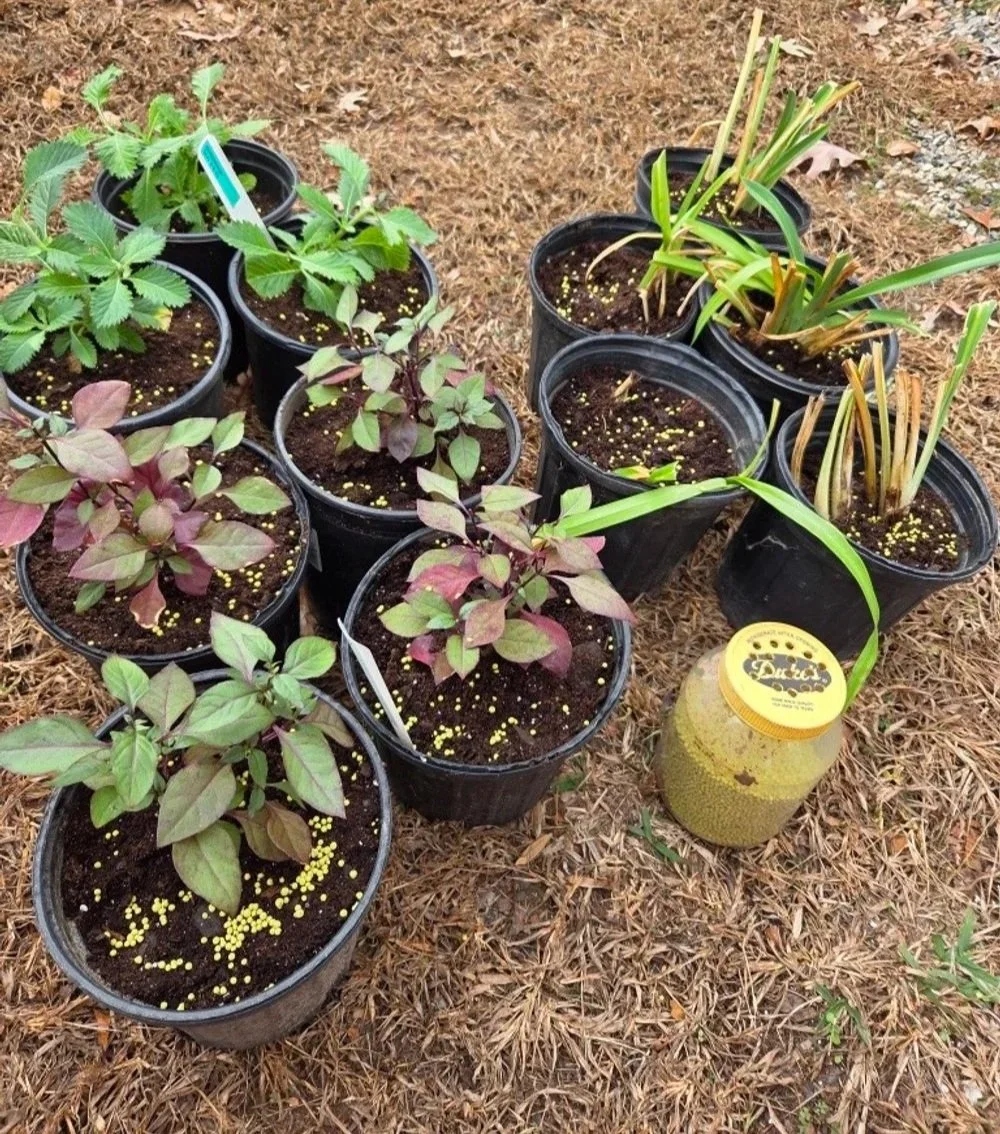
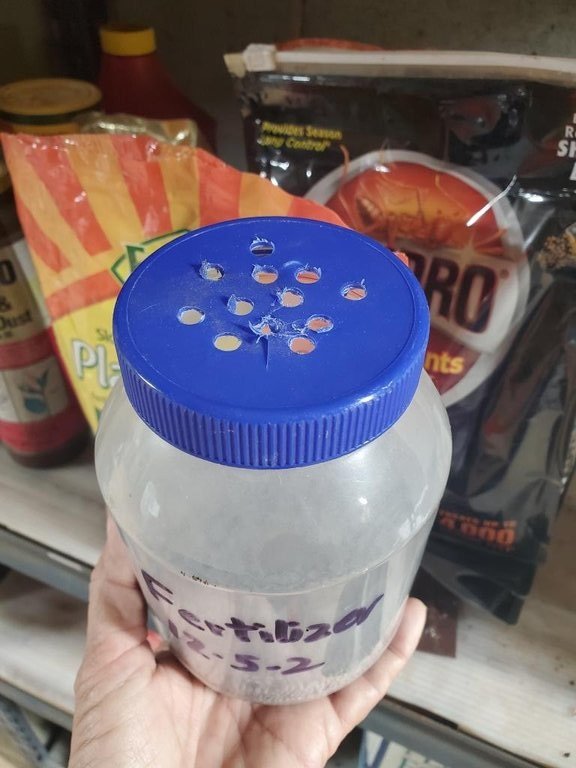
Here, I have moved the Alternanthera, the Coleus, and Centrantherum (“Lark Daisy”) to one gallon containers for the winter. And here is my final gardening tidbit for this blog: To apply the time-release fertilizer that will keep these plants well-fed until spring, I took an empty plastic one-quart container, washed it well, and used a small bit to drill a bunch of holes in the plastic lid. This works like a large salt-shaker to apply fertilizer (or any pelletized product) easily and evenly. I have multiple lids, with different diameter holes. Milorganite, for instance, is a small pellet that requires a smaller gauge hole for ideal distribution.

Alternanthera, Centrantherum, and a few Daylily divisions are potted up and ready to overwinter in the greenhouse. I pinched the growing tips and removed the flower buds to encourage stocky, well-branched specimens.

 Happy Thanksgiving to you and yours.

Garden Geek Speak: Buffer pH

Summer is winding down, and it is time to start thinking about next year’s garden. One of the smartest things a gardener can do is to submit a soil sample to the nearest extension office. For a nominal fee, a University lab will evaluate your soil and provide a list of recommendations on amendments.

Why test soil now instead of next spring? Many southeastern beds, borders and lawns need an application of lime (limestone) to adjust the pH of the soil. Without a correct pH, plants cannot efficiently absorb available nutrients. Lime works slowly. Obtain your recommended application rate now, apply it after the end-of-summer cleanup, and allow fall season rains to carry it into the soil where the adjustment process will take place during winter.

Because my gardening beds are not located near each other, they have different needs. I select three areas each year for soil testing. Recommendations are geared toward the plants grown in the test area, so my blueberry beds will have one set of recommendations, my shade garden (hostas and ferns) will have another, and the perennial beds on a rocky southwestern slope will have yet another. Next year I will select three different areas for testing. While you could test annually, I find that once every three years is sufficient.

Fortunately, the University-generated amendment recommendations are spelled out in terms almost anyone can understand. For instance, here is the recommended zinc application for new pecan trees: Use 1 pound of 16-4-8 or 1½ pounds of 12-6-6 fertilizer distributed in a 25-square-foot area around the tree. Make this application immediately after planting and again in June or July. The following February, apply 4 pounds of 16-4-8 or 5 pounds of 12-6-6 fertilizer for each inch of trunk diameter (measured 1 foot above soil surface). Pretty clear, yes?

There is one item on the soil analysis which is confusing. There is one number for Soil pH and another number for Buffer pH. The two numbers are not the same. What is the difference? Simply put, Buffer pH measures a soil’s resistance to change. A soil with high clay content will take a different quantity of product (lime, sulphur or aluminum) to effect pH change than a soil with high sand content. The soil pH meters sold in garden centers can provide a measurement of soil pH, but they cannot give an application rate based on soil structure.

Don’t waste time and money with guessing. I learned this the hard way. After applying 10-10-10 fertilizer to my beds for years, my first soil test indicated a phosphorus level that was off the chart. (I like to blame Martha Stewart’s garden book recommendation for Triple SuperPhosphate, but the fault is all mine. Her Connecticut soil needed phosphate. My South Carolina soil did not.) Out of balance soils take time to correct. It took several years before my excessive phosphorus dropped to a normal level. Before I knew better, the addition of 10-10-10 always made my plants look better short-term as they took up the available nitrogen. Nitrogen leaches out quickly, so as soon as the first flush of growth subsided, plants looked a little unhealthy and I added more 10-10-10 or 17-17-17, making the imbalance worse. While it seems that a fertilizer “with added micronutrients!” should be superior, it is only better if your soil actually needs those micronutrients.

Following the instructions provided, gather a soil sample and stick to the resulting recommendations. It is important to follow good sampling technique so that the resulting recommendation is accurate. As a side note, it is usually unnecessary for homeowners to pay extra money for a lab-generated Organic Matter Test. It sounds like it should be useful, but this measurement is used by farmers to calculate how much herbicide they need for crop treatment.

When spreading lime or fertilizer in a narrow bed, perhaps one surrounded by lawn or patio, it is difficult to use a mechanical spreader without getting the product where you don’t want it. Spreading by hand can be uneven and tiring if your beds are large. Here is my method: Take a clean, empty plastic quart container (mayonnaise jar is perfect). Remove the top and use an electric drill to make holes in the lid. For fertilizer, I use a 3/8” bit and make a lot of holes. Adjust your hole size and quantity to the product you are spreading. Fill the dry container with fertilizer or lime, attach the lid and you have a giant “salt shaker.” The light weight of the container makes for easy application. I keep one of these homemade spreaders in every bag of fertilizer, ant bait or pelleted insecticides. If you measure the correct amount of fertilizer for the given space into the jar, it is easy to avoid applying too much.

Clear plastic jar with blue lid, numerous small holes in lid