insects

Chigger Bites - How to prevent them and what NOT to do

I was at a semi-social gathering last night when the subject of chiggers arose. Allow me to clarify: this was a meeting of Master Gardeners. Unlike many of the greater public, we are entertained by conversations concerning insects, weeds, and plant diseases the same way my dog-training friends talk about breeding lines and canine health issues, using words rarely heard in polite society. Anyway, someone made the comment, “Have your nail polish ready.” She said this in jest, but it reminded me that some people are uninformed about these nasty little pests.

Usually, the first thing someone will tell you about chiggers is that they burrow under your skin, and must be smothered to stop the intense itching and inflammation at the site of the bite. There are insects that burrow under the skin, but chiggers are not one of them. Instead, chiggers find an area where the skin is thin and tender and insert their piercing mouth parts into the pores of the skin. Instead of sucking blood like a tick, they inject a digestive enzyme that literally liquefies your skin cells and lymph, so they can suck up your juices. (Just as disgusting as it sounds.) It is this enzyme, injected into the skin, that causes the itchy reaction in most humans.

The enzyme fluid has a two-fold effect. It initially liquifies the victim’s cells, and then it hardens to form a straw-like feeding tube, called a stylostome, through which the chigger can continue to feed. This hardened stylostome may appear as a red dot in the center of the bite. The red dot leads people to believe that the chigger itself is still present. Hence, the age-old recommendation to paint over the dot with nail polish, allegedly to smother the pest.

Unlike mosquitos, with their sharp mouth probes, the mouth parts of chiggers are fairly weak. The chigger has to find a tender area to attach, and often needs something to push its legs against in order to force its mouthparts into the skin. This is why you seem to get bitten around the edges of socks, the elastic bands of underwear, waistbands, and cuffs. The tight clothing gives them something to push against while they attach.

Unlike ticks, chiggers don't embed very deeply, and are fairly easy to remove. Even a brisk shower is enough to dislodge them, which is why showering immediately after time spent outdoors in chigger-infested undergrowth or long grass can minimize their opportunity to inject you with their toxic juices. They can easily be brushed off but they are so tiny that they are rarely seen with the naked eye. A chigger measures 1/60th of an inch. That is 0.4233mm, for those of you who are metrically-inclined. Chiggers can attach to their host for up to three days.

My home garden is edged by stacked stone walls. I frequently see little red insects skittering about on the stones, and I assumed those were chiggers. Not so! Those are red velvet mites, Trombidiidae. They are large enough to see easily, which makes them easy to distinguish from tiny chiggers, which are almost invisible without magnification. Red velvet mites are harmless to humans. They parasitize other insects. Don’t squash them with your fingers, though. They leave a bright red stain on fingers, siding, or stone that lasts a long time and cannot be removed by simple washing.

How to deal with the chigger issue:

  1. The person who is chigger bitten will start to feel the itch three to four hours after the initial bite. The worst of the itching begins as late as 24 to 48 hours after the bite has occurred.  You can use drug-store products to help relieve the itching, but prevention is better than treatment. 

  2. Insect repellants are effective. If you decide to use repellant, apply it to ankles, legs, waists, and sleeve areas, where chiggers are most likely to mount their invasion.

  3. Wear protective clothing, like long pants tucked into boots. Tightly woven fabrics prevent them from gaining access to your skin.

  4. Avoid heavy underbrush or tall grass. If you must walk through these areas, shower as soon as possible. My personal worst chigger attack came from wandering around an unmowed church cemetery as a child. The resulting itchy red rash resembled a case of measles.

  5. Wash your clothes too. Chiggers can linger in clothing and drop off inside your house, or attack you the next time you wear those items.

So, nail polish has no positive impact when painted over those red dots on your skin. You are not suffocating the chigger, because it is not embedded in you. If you decide to use nail polish anyway, let me warn you that using nail polish remover when you have those little open places on your skin will get your attention, and not in a positive way.

If there is any bright side to the misery of chigger bites, it is that unlike ticks and mosquitos, chiggers are not known to carry or transmit any diseases.
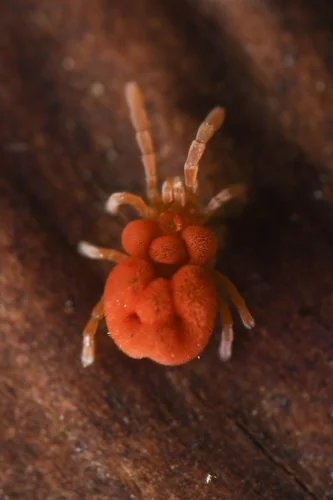
This image of a Chigger was taken by Trevor Van Loon and shared to iNaturalist under Creative Common license 4.0. Click on the image to go directly to the iNaturalist page.
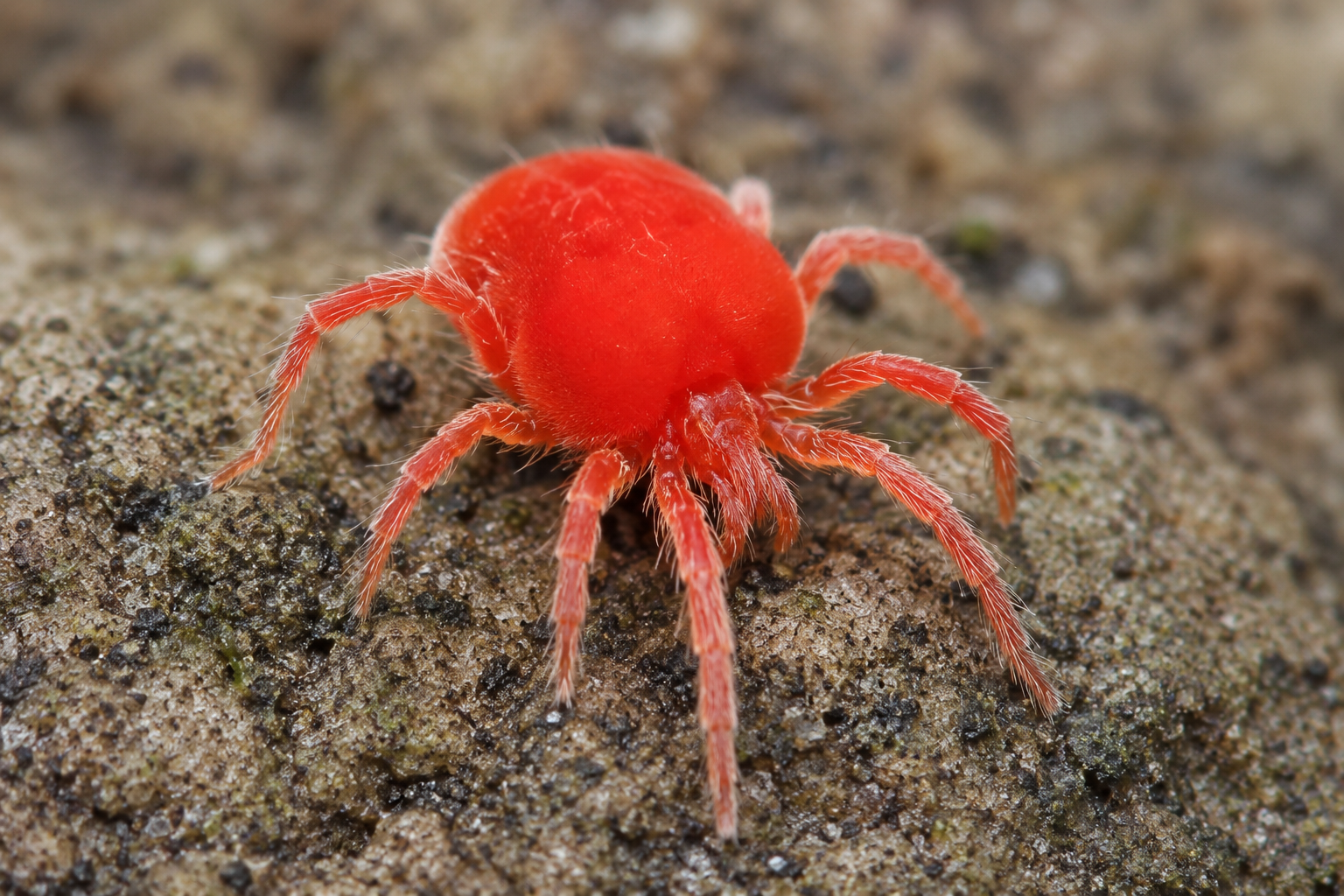
Red insect with eight legs

This is an AI generated image of a chigger. They are so tiny that it takes someone with patience and a superior camera lens to capture an image. Remember: Size is 1/60th of an inch.

How to Get Rid of Mealybugs Before They Destroy Your Plants

I have a couple of “mother” Coleus plants in my greenhouse. I take cuttings from these in November or December, root them in starter cells, then move the rooted cuttings to four-inch containers. I grow them into transplants to set out when threat of spring frost is past. Using large starter plants gives my garden a hint of future lush appearance while bedding annuals are still tiny. The tag from my mommy plants is long gone, but I believe it is ‘Freckles,’ a personal favorite because the yellow and orange splotched leaves look good with the Melampodium I grow every year. The source plants are not pretty – taking cuttings means they are misshapen and stubby looking. Still, I can pull at least a dozen healthy cuttings from them annually. Until this year, that is.

I have very few plants that remain in the greenhouse during summer months, since plants I propagated or overwintered have moved to their outdoor summer locations. I disengage my automatic watering system during summer, so I visit the greenhouse every other day to manually water and ensure health of the few plants that remain. Imagine my disappointment when I found that my Coleus had been overtaken by a mealybug infestation that left them damaged beyond a hope of recovery.

Mealybugs are scale insects that suck the juices out of plants like Coleus, Cactus, Poinsettia, Rosemary, and many houseplants. Under magnification, they look like roly-poly bugs wearing white parkas. They can weaken plants to the point of death.

They are difficult to get rid of, requiring a three-prong approach. If the invasion is caught early, you may be able to control them by the first step only. First, use rubbing alcohol and a cotton-tipped swab to remove their bodies. Be careful to remove any eggs visible. Eggs are tiny, so a follow inspection is required. An alternate first treatment is to wash them away with a sharp stream of water. Second, applying a horticultural soap or oil will suffocate them. The oil will also smother any that are hiding in the tiny joints where leaves meet stems. And third, a systemic insecticide will kill any new bugs that decide to feed on the treated plants. Alcohol-soaked swabs and horticultural oils will kill adults but the eggs will be undamaged, so be prepared to repeat treatments several times as eggs hatch.

I reserve systemic insecticides for special or dire situations, since they kill good bugs along with the bad ones. Products containing the systemic Imidacloprid are widely available in garden centers and home improvement stores. Follow application instructions precisely.

I think flowers detract from the beauty of Coleus, so I remove flower buds as soon as I see them. Without flowers, pollinator damage from systemic poison is less of a concern. The bonus of flower removal is that it functions as a form of pruning that forces plants to bunch, making them look fuller. Unpinched plants tend to look rangy by season’s end, so I regularly pinch back to a pair of leaves even when they are not forming buds.

The best way to treat mealybugs is to prevent them if possible. Too much nitrogen leads to soft growth, so fertilize judiciously. Do not reuse potting soil that has been exposed to mealybugs, since their eggs can easily hide in soil. Sanitize tools and any pots you reuse. Quarantine any new arrivals for a day or two to ensure no hitchhikers. Most important: Inspect plants often so that problems are caught early.

A close view of a long-tailed Mealybug. Photo D-Kuru, CC BY-SA 3.0 AT

This is the sad result of a mealybug attack on a Coleus in my greenhouse.

Do Not Pet a Velvet Ant

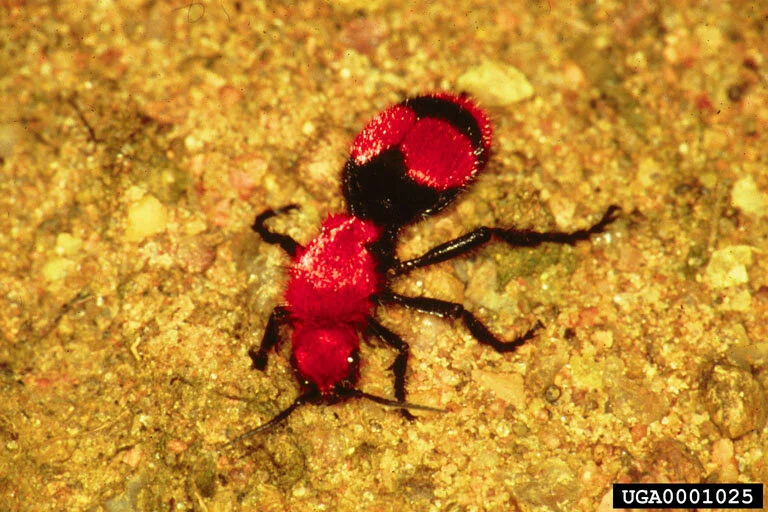
A huge (about ¾ of an inch) red and black ant made an appearance in my garden this week. I see them every year in late summer. As bugs go, they are pretty in their flashy velour coats as they twitch and scurry around. Their rapid movements give a hint to their true identity. Despite its resemblance, this is NOT a member of the ant family. Instead, it is a wasp, Dasymutila occidentalis. Females do not have wings, which strengthens the ant-like appearance. Both males and females can reach up to one inch in length. The female has a stinger up to ½ inch.

Its common names include Velvet Ant (due to its fuzzy-looking body) and Cow Killer. The latter arose from folklore saying that the sting is so powerful that it can kill cattle. This is an exaggeration, of course, but the sting is very much like a paper wasp. A big, angry paper wasp. Do not be tempted to mess with this character. It is not aggressive but will sting if threatened.

Velvet Ants do not live in colonies, preferring life as loners. They feed on the larvae of bees and wasps. Their small numbers mean they do not have much of a negative impact on good bee populations. Velvet Ants are tough customers, with flexible bodies that almost refuse to be squashed. They are not bothered by other insects, perhaps due to a nasty-smelling odor they emit as a deterrent. If injured (by your work boot, perhaps) they give off a high-pitched squeal. Their squeals will never exceed the volume of the one you produce if you step on one barefoot.

This amazing closeup photo was taken by Jerry A. Payne, USDA Agricultural Research Service, and found on Bugwood.com   ( https://www.insectimages.org/browse/detail.cfm?imgnum=0001025#collapseseven)

This amazing closeup photo was taken by Jerry A. Payne, USDA Agricultural Research Service, and found on Bugwood.com ( https://www.insectimages.org/browse/detail.cfm?imgnum=0001025#collapseseven)