Hellebore Black Death Disease (Virus)

Lenten Rose or Hellebore is one of the easiest, most reliable groundcovers for shade gardens and woodlands. So, I was surprised to receive three inquiries in the past month about dead or dying plants, with pinched stems and black-spotted leaves. My first guess was boggy soil. We have enjoyed plentiful rains this spring, so clay soils in poorly drained areas may be swampy enough to encourage root rot. A little more digging, though, uncovered a new, previously unknown (to me) culprit:  the virus Helleborus Net Necrosis Virus (HeNNV), also known as Black Death.

The virus presents with blackened, stunted or deformed leaves and can include a strange netting pattern around the leaf veins. Young, tender growth is usually first to be affected. Stems and flowers can also show signs of the virus. One of the earliest signs is puckering of the leaf surface around the veins. Don’t confuse HeNNV with fungal diseases like Hellebore Leaf Spot, which presents with rounded red or brown spots on leaves, usually seen in autumn and treatable by removing the damaged leaves. HeNNV is viral, not treatable.

The New York Botanical Garden LuEsther T. Mertz Library has a great article on Hellebores. Here is what they say about the Net Necrosis Virus: “The black death virus has been observed in Europe since the early 1990’s. Studies of the disease by Washington State University, examining strains found in the United States, determined that this disease is a Carlavirus, a group of viruses transmitted by insects for which plants serve as hosts and distinct from any previously encountered viruses. The insect vector for this disease has been assessed to be the hellebore aphid, which proliferates on hellebores. Not all aphid species are able to transmit all viruses and other aphid species have not yet been demonstrated to transmit this disease. It is believed to be carried on the feeding parts (stylets) of aphids but is not internalized (non-persistent transmission), thus the disease is carried for a period no longer than a few minutes.

Because the virus is transmitted on the feeding parts of aphids, preventing feeding is the most promising management technique in nursery greenhouse settings. There are systemic insecticides that are licensed for these settings in some states. Use of insecticides on home gardens to deter aphids, however, would not be effective or practical as a very short-interval repeat of application in an open environment would be needed.” A photo of a virus-stricken plant is included with the article.

Strong-growing plants may show more resistance to the virus. Humus-rich, well-drained soil and good air circulation help keep plants healthy. I have read that a fertilizer heavy in potash, applied once or twice a year, will help keep Lenten Rose a rich, healthy green. I have not tested that myself nor have I read university research on this topic, so consider that as “maybe” information only. Potash is the K in NPK on fertilizer bags. Many fertilizers that are labeled specifically for tomatoes contain an elevated amount.

What do you do if you spot a troubled plant in your own garden? Dig it up, bag it, and send it out with the trash. Do not add diseased plants to the compost pile. If you catch the problem early, you may be able to prevent its spread to surrounding Hellebores.

Thus far, I have only developed one suggested alternative plant as a Hellebore replacement. That plant is Evergreen Solomon’s Seal, Disporopsis pernyi. Hardy in zones 6-9, it has arching stems that resemble a very short Leucothoe. It has tiny fragrant flowers in spring, spreads rapidly, and is deer resistant. While they are both in the Asparagaceae family, Evergreen Solomon’s Seal is not in the Polygonatum genus of deciduous Solomon’s Seals. If evergreen foliage is not important to you and your garden, please also consider Polygonatum humile, Dwarf Solomon’s Seal. It reaches nine inches in height and makes a lush groundcover in woodland areas, hardy in zones 5-9. I have ruled out Pachysandra as a good replacement (too slow, too temperamental) but Sweet Woodruff, Galium odoratum, is still under consideration.

Winter sun backlights this healthy Hellebore.
Stinkhorn Mushrooms Live Up to the Name

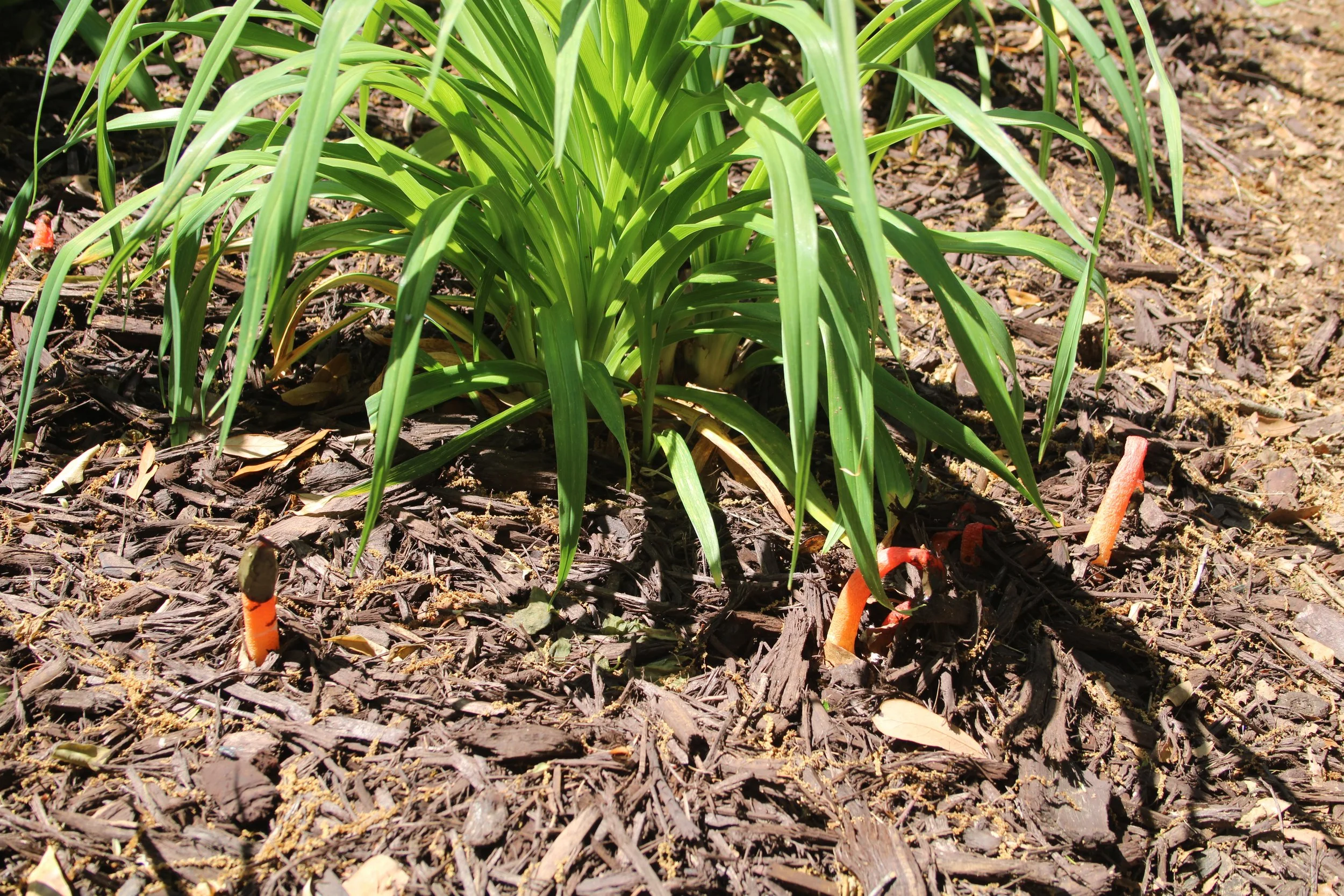
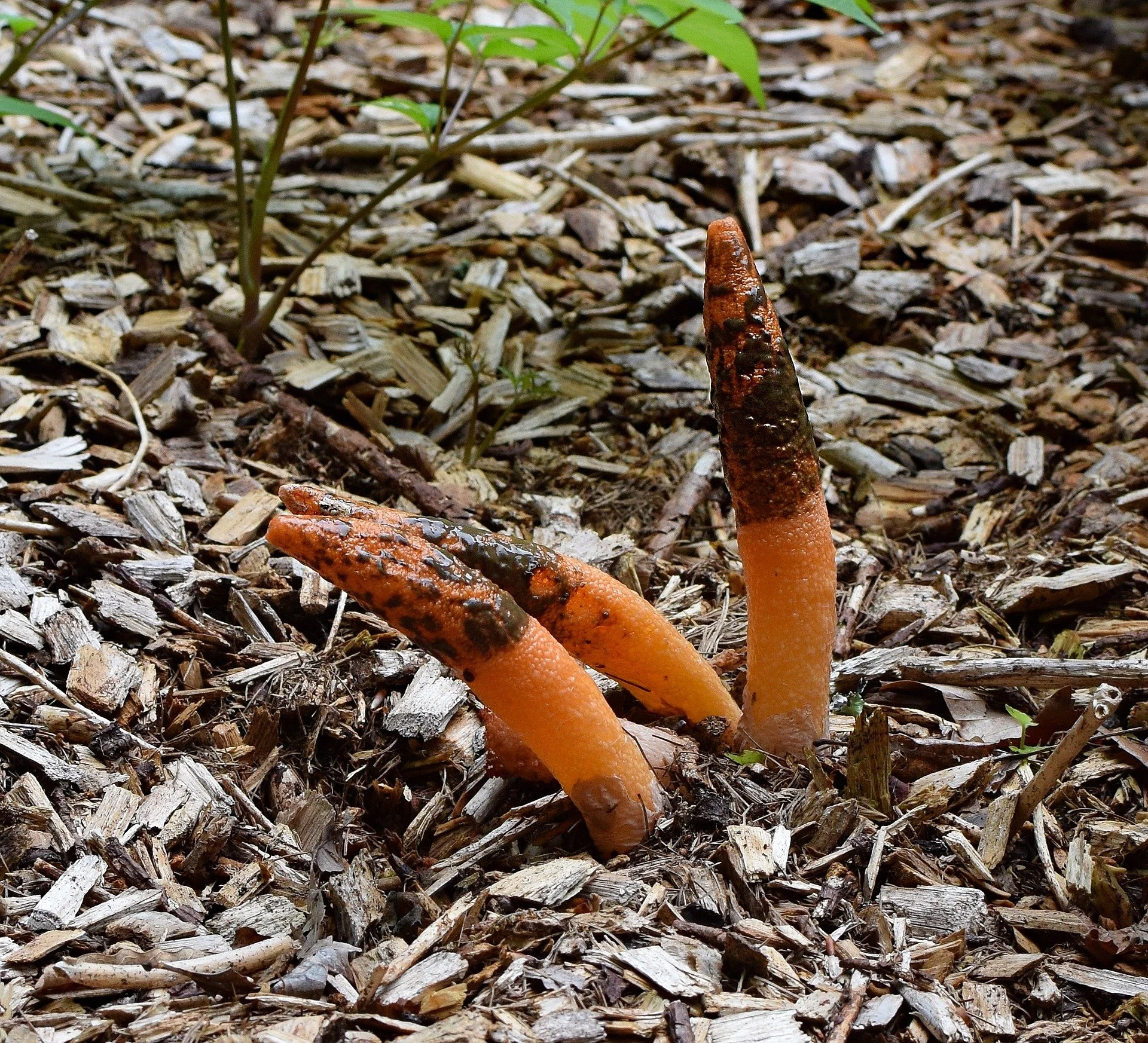
A crowd gathered in the garden of a friend recently. I assumed they were admiring a new plant, so I hustled over to share in the appreciation. But no, this was no new perennial. Emerging from the mulch was a group of orange finger-like growths wearing dark brown caps. Their slightly naughty appearance spurred a lot of jokes. When I bent down to take a closer look, the nasty odor caught me by surprise. My brain churned a minute until I was able to dredge up its proper identity: Stinkhorn Mushroom. There are several forms of the stinkhorn fungus, ranging from rounded to those in front of my group, shaped like something you would see for sale in the classified section of an adult magazine. Common names for stinkhorn mushroom include Devil’s Dipstick (my favorite), Demon Fingers, and Dog Stinkhorn.

Stinkhorn mushrooms grow on rotting wood – decaying stumps or mulch, for instance. They can be found across the US, usually after a period of damp weather, The dark cap on top of the horn is a slimy mass of reproductive spores. This is where the “stink” in stinkhorn arises. The smell is described as sewage-like or compared to rotting meat. Unlike a normal fungus whose spores are spread by wind, the stinkhorn’s brownish cap atop the pinkish-orange horn contains a gooey collection of spores. These spores hitch a ride on insects who spread them about. The stench helps lure pollinators (those with a warped sense of smell, I assume) such as flies, ants, beetles, or bees. Insects who consume this odd mushroom then excrete the spores to begin a new generation.

Despite their evil appearance, stinkhorns are not poisonous and they do not transmit diseases to plants. If they appear in your garden, please leave them alone. They should not be treated with antifungals or herbicides. They are excellent decomposers. They only feed on dead plant tissue, so do not pose any threat to live, healthy plants. Stinkhorns are short-lived and offer amusement to garden visitors. Just don’t stand down wind.

These stinkhorns made a surprise appearance in a friend’s garden, just in time for a garden club meeting.

Agapanthus or Lily-of-the-Nile for Containers or Ground

Agapanthus (pronounced ag-ah-PAN-thus) or Lily of The Nile makes me think of Allium, but the leaves are more substantial and the bloom appears more robust. Given a choice between the two, I would choose exotic-looking Agapanthus. I attempted to grow this plant many times in the past. My plants would last a year or two, and then would dwindle away or even die outright during a cold, wet winter. New cultivars are on the market now, with enhanced cold tolerance, so I am trying again. Some varieties are evergreen while others are deciduous. Check the label to know what you are buying.

Agapanthus is a fleshy rhizome that hails from South Africa. Another common name is African Lily. It prefers at least a half-day or sun or more. The labels indicate cold hardiness from zone 8 through 11. If you live in a cooler area, you can grow Agapanthus in containers and bring them indoors when winter arrives. Be careful to avoid overwatering in winter.

Most Agapanthus flowers are in shades of blue, but purple and white forms are available also. Individual leaves grow to three inches wide and 12 to 24 inches in length. Dwarf forms are available. The flowers are umbrels, clusters of individual flowers that appear as a single flower atop a sturdy stem. Each small flower has six petals; most have a darker stripe down the center of each petal. A fully opened flower is approximately the size of a tennis ball. This year, I paired a white cultivar with blue flushes (‘Indigo Frost’) with a white-flowered Mandevilla vine in a container with an added trellis.  I have high hopes for this combination. The Mandevilla has not started to climb its trellis yet, but I think it will be an ideal paring. Ultimately, the Mandevilla vine will serve as a windbreak and a visual backdrop for the Agapanthus flowers.

Agapanthus likes a well-drained, moist soil of neutral pH. It will not tolerate constantly wet soil. For best flowering, fertilize in early spring and again after flowering concludes.

Be patient with Agapanthus. It takes a year or two for it to reach its full potential. Rhizomes will enlarge and plants will spread over time. The seeds of spent flowers can be harvested and will germinate but it takes several years for seed-grown specimens to begin flowering. Propagation by division is a faster method. Plants bloom best when rootbound, so don’t be quick to separate. Use care when dividing ground-grown plants, as the thick feeder roots spread widely and shallowly. It is best to divide congested plants in autumn rather than spring.

Agapanthus leaves are toxic if eaten and the sap can cause skin irritation. This does not impact hummingbirds and other pollinators, who love visiting the blooms, but it deters nibbling from deer.

This newly planted pairing will be beautiful once the white-flower Mandevilla starts to cover the trellis.

The Sweet Scent of Summer Rain

My garden welcomed the recent rains after almost a week of dry weather. Along with the rain came that wonderful, earthy smell known as “petrichor.” This scent is noticeable when rain falls on dry soil. The smell comes from a combination of factors.

Texas A&M University described the main source of the odor thus: “The main contributor to petrichor are actinobacteria. These tiny microorganisms can be found in rural and urban areas as well as in marine environments. They decompose dead or decaying organic matter into simple chemical compounds which can then become nutrients for developing plants and other organisms. A byproduct of their activity is an organic compound called geosmin which contributes to the petrichor scent. Geosmin is a type of alcohol, like rubbing alcohol. Alcohol molecules tend to have a strong scent, but the complex chemical structure of geosmin makes it especially noticeable to people even at extremely low levels. Our noses can detect just a few parts of geosmin per trillion of air molecules.”

Plant oils are another contributor to the smell. Plant leaves secrete these oils almost like they are producing their own sunscreen, but the goal is to reduce moisture loss through transpiration. Rainfall rinses those oils into the soil and into the surrounding air. In a 2015 study, scientists used high speed photography to capture raindrops causing tiny particles to be ejected into the air. The technical term for this is “frenetic bubble generation.” MIT describes the process as similar to bubbles rising in a glass of champagne.

The scent of rain can also be enhanced by ozone resulting from lightning that occurs during summer thunderstorms.

The different factors combine to create a smell that people can detect – those of us with good sniffers, that is. My grandfather could always predict a rain before it started without the benefit of doppler data. Now, I settle into a comfortable porch chair when the rain starts, sip a glass of iced tea, and enjoy that sweet smell, Mother Nature’s perfume.

Keep Cast Iron Containers Cool

A traditional favorite gardening container material is cast iron. Cast iron urns are beautiful and elegant, but are very heavy. Painted cast aluminum is a popular substitute because it does not rust and it is not quite as weighty.

In the deep south, the walls of metal plant containers capture heat in summer. They transfer heat to the soil within, to the detriment of the plants growing within. One way to prevent hot metal from damaging tender roots is to provide an insulation layer between the pot and the potting soil. I have tried several different strategies. The most effective insulator I have found is bubble wrap, the kind used for protecting delicate items during shipping. It is inexpensive, flexible, and malleable to fit the nooks and crannies of elaborate containers. Simply cut a piece of wrap that is large enough to line the inside of the container. Place the wrap around the outside container walls, being careful to avoid blocking any drainage holes. It is easily trimmed to size with scissors, so that there is no excess visible above the soil line. Add regular potting soil inside the bubble wrap layer, and – voila! – the soil will not become scorching hot because it is not in direct contact with the metal. The thin material does not reduce the amount of soil available to whatever plants you choose for your container.

Another tidbit: Reduce the amount of potting soil needed by large containers by adding a layer of pine cones in the bottom, before adding soil.

This iron urn is lined with bubble wrap prior to the addition of potting soil.

A green and white combination looks classy and cool, even in the heat. Container contents: Diamond Snow Euphorbia (a filler), Rosemary (a thriller), and a double Calibrachoa (a second filler). Not shown, an ivy with a white leaf edge (a spiller). The Rosemary is evergreen, so it can carry over to anchor a winter container.

The completed planting. In a couple of weeks, the Rosemary will gain height and be a vertical center accent. The strong pine-like scent of Rosemary repels some insects. I’m hoping that it will keep mosquitos away from the seating area near this container, one of a matching pair.

Caladiums for Color in Shade

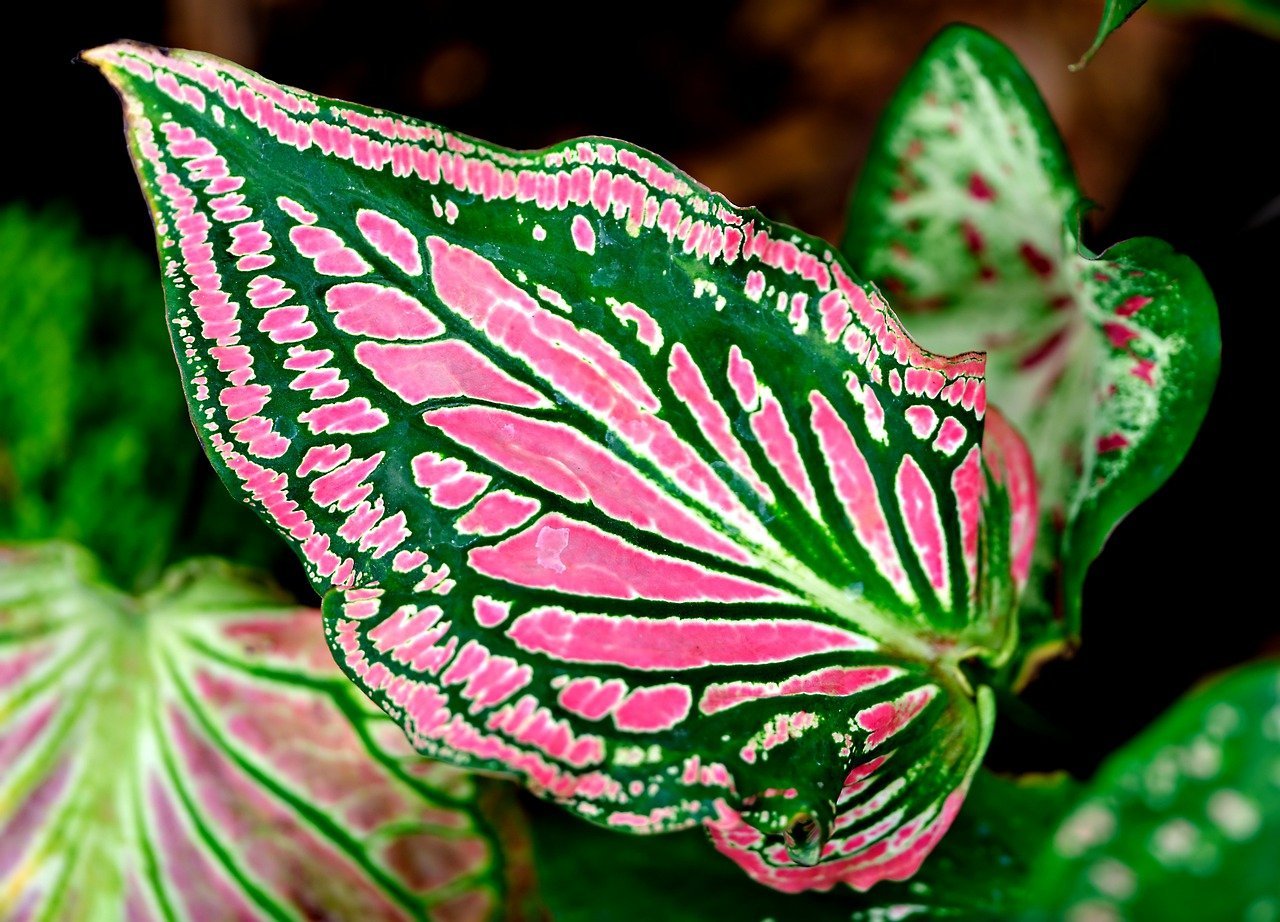
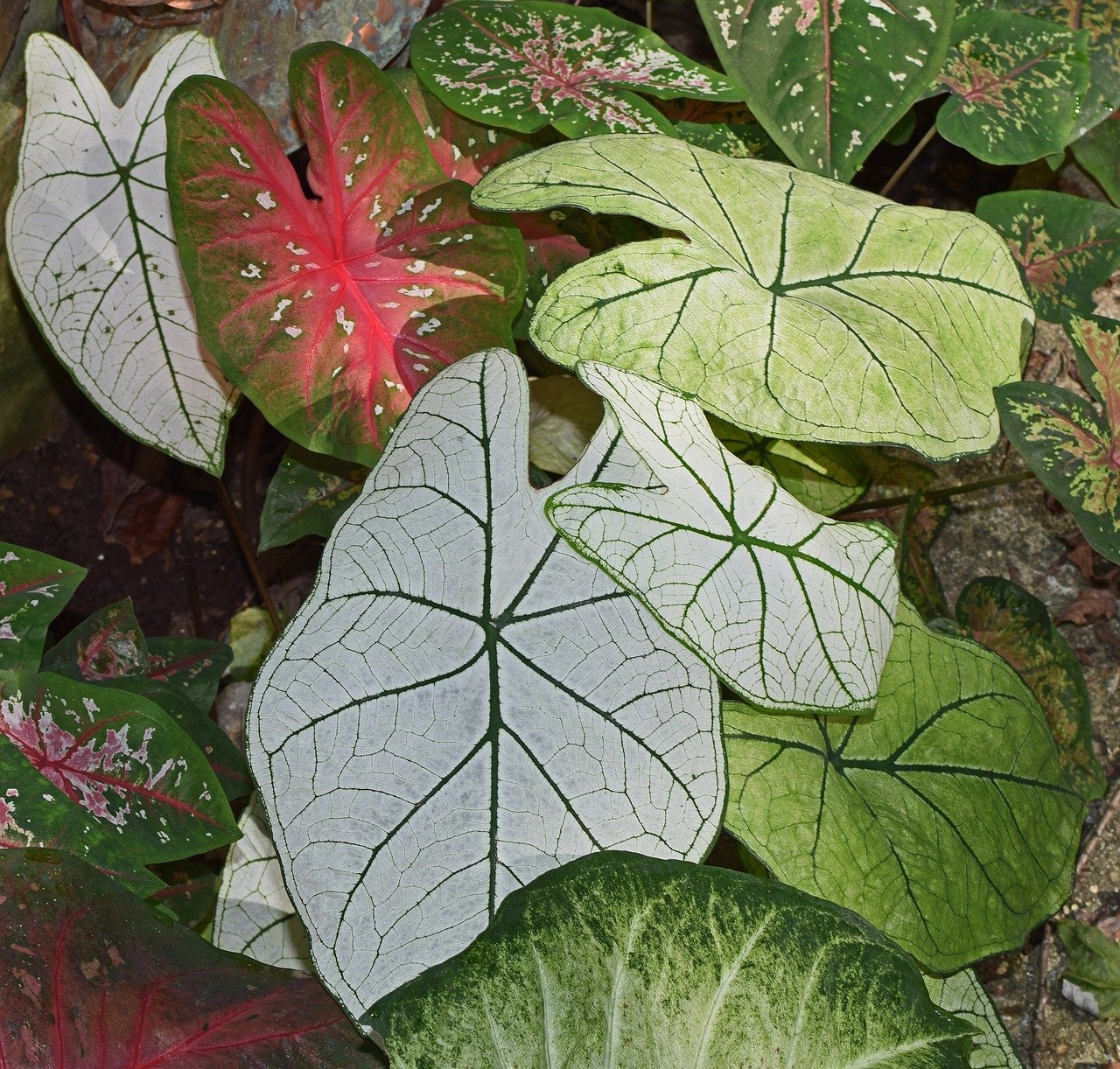
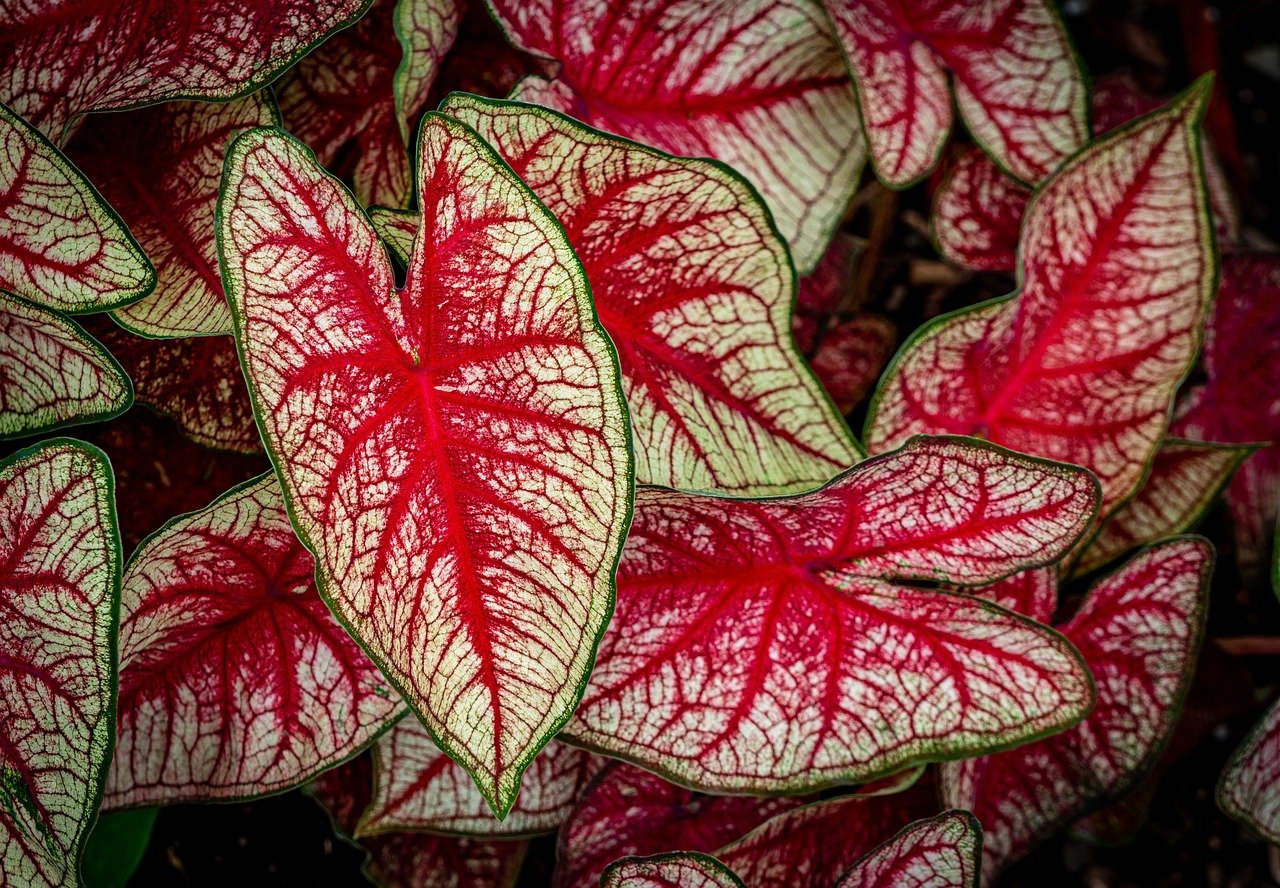
Caladium (pronounced ka-LAY-dee-um) is a genus of tubers grown for their colorful summer foliage. Heart-shaped leaves grow up to 15 inches long and 10 inches wide, in freckled or streaked shades of pink, white, rose, red, green, burgundy, and occasionally yellow.

Plants are perennial in zones 9 and warmer. Some gardeners opt to grow them as annuals. They look fabulous in shady beds or hanging baskets. They can also be grown as houseplants by those who enjoy a challenge. Caladiums prefer moist, acidic soil that is high in organic matter. They prefer shade or partial shade, and pair well with Begonia and Impatiens. Mature height is less than two feet, so situate them where they will not be blocked by taller plants.

Caladiums enjoy the same water needs as Hostas and ferns. Like Hosta, they are targets for damage by snails and slugs. Placing them in the same bed as Hostas makes it easier to restrict chemical use to a limited area. My favorite products to eliminate snails are Sluggo or Escar-Go. Both are iron phosphate products that are non-toxic to humans, pets, and fish. I’ve read mixed reviews on whether it is harmful to earthworms. If you want to check out this type of molluscicide (fancy word for slug-killer), be sure to append your search with “site:.edu” so that your results will be ONLY university-based research articles and not product advertisements or non-science based opinions.

Caladiums enjoy a fertile soil, but excess fertilizer will cause the new leaves to trend toward green instead of colorful variegations. Use a time-release fertilizer or monthly application of diluted liquid plant food.

Tubers, an irregular shape, are available in garden centers in early spring. Full size, pot-grown specimens are sold a few weeks later. Larger bulbs produce larger plants.

Caladiums refuse to grow until the soil has warmed to at least 70 degrees, so there is no point in planting them before May. Earlier planting may result in rot. The foliage makes a remarkably long-lasting addition to the cut-flower arrangement. While Caladiums do bloom occasionally, their flowers are barely noticeable. Remove the flowers (spadix) if desired to direct more energy to leaf growth.

The mostly-white types look smashing when paired with white Impatiens. Some of the most popular varieties are ‘Freida Hemple’ and ‘Fanny Munson.’ Others, ‘Rosebud,’ ‘Red Chief’ and ‘White Queen’ will tolerate more sun (3-4 hours) than most. Some cultivars feature a “strap leaf” form with narrower leaves or ruffled edges. If Caladium leaves begin to twist, it is a sign they are not happy with their location – either too much or too little water, or too much sun.

If you choose to store your tubers from year to year, prepare to lift them in autumn. When cool weather approaches, withhold water for a few days to help them enter a dormancy period. Lift the tubers before they are touched by frost. Allow them to dry a few days out of direct sun, brush off excess soil, then store them in peat moss or vermiculite until next year. It is difficult to determine which way is “up” with the dried tubers. The smooth side is the bottom. Plants will still sprout if planted upside down, but position them vertically (edge up) to play it safe.

While many bulbs need a period of cool weather to rest, Caladium is an exception.  The tubers’ storage temperature should never drop below 50 degrees, or they may not recover.  For most of us, this means keeping them inside the house rather than in an unheated garage or garden shed.  Just don’t forget where you put them (a sad personal experience).

All part of Caladium are toxic to humans and pets if eaten. The sap causes a rash for sensitive-skinned gardeners, so use caution if leaves are gathered for flower arrangements.

Additional cultural tidbit from our friends at Clemson Extension Home & Garden Information Center: “Each caladium tuber has a large central bud surrounded by several small buds. Most caladium varieties produce only a few colorful leaves when the prominent central bud is allowed to grow. Remove the central bud to allow the tuber to produce many more shoots and leaves. Use the tip of a sharp knife to lift out the large central bud, being careful not to injure any of the surrounding small buds.” (HGIC Factsheet 1160.)

Garden Sharing and Caring

My garden is located on the NC/SC state line, in a zone which has finally passed the date for last frost. I have been outdoors every day, planting seedlings and pulling weeds. No matter how hard I try, the weeds appear faster than I can remove them. Typically, I select one plant to research for this weekly blog, but yesterday as I rested in the shade, I looked around at the plants that moved with me to my current home. My landscape is not just a garden, it is a testimony of friendship. So, today’s topic is sharing.

Many gardeners have themed areas or outdoor rooms: Pollinator gardens, sensory gardens, moonlight gardens. I don’t have any of those. Instead, I have a Friendship Garden. When I see Blackberry Lily, I recall my friend Pam, now deceased. Hardy orchids remind me of Linda, Epimedium means Cindy, and Crinum lilies recall Neil, a generous customer from my days working in a nursery. Ginger Lily means Melissa, a Ginkgo ‘Saratoga’ says Barbara, yellow coneflowers whisper Janice, and the Hardy Begonia reminds me of Pat. Iris ensata testifies my friendship with Cathy. Shasta Daisies and Crystal Falls Ophiopogon tell of Jane’s generosity. So, so many others.

Everywhere I look, I see not just the plants but the dear friends who shared cuttings, seeds, or bulbs with me. Gardeners are generous people who enjoy sharing their successes and commiserate with failures. Only my closest friends did not question my sanity when I spray painted the dead spots in boxwoods (two shades of green for realism) before our home wedding reception. Those same friends volunteered labor when straight-line winds took down a tree and a storage building the week before a scheduled garden tour.

There is a rarely-mentioned benefit to sharing plants with your friends. If you lose a plant due to disease, insects, animals, or some other reason, you know a ready source for replacement cuttings, seeds, or bulbs. Sharing is one of the best ways to hedge one’s bets, and I encourage you to be generous when someone admires a plant featured in your landscape.

Sadly, there is a corollary to this advice. There is an emotion somewhere between rage and disappointment (rageppointment?) when one has shared a plant – a plant that you have nurtured from a tiny cutting, giving it love and care until it was large enough to rehome – only to learn that the recipient has allowed it to languish and die. I realize that life sometimes gets in the way, but if I have given you three beautiful Hostas and you tell me that they succumbed when you planted them in the baking sun next to your garage, don’t be surprised if I fail to offer you replacements. It is disheartening when I drive by your home and see one of my plant foster children sitting in the bone-dry zone next to your garage, unwatered and unloved, dead as the tag emerging from the lifeless dirt. My donations are easy to spot, because my labels are distinctive.

Please, if you accept a plant from another’s garden, commit to getting it in the ground where the sun exposure meets the plant’s needs. If you cannot do that in a timely manner, just tell the one making the offer that you don’t have the time right now, you cannot offer the plant what it needs, or it doesn’t fit in your color scheme. Honesty at this point increases your chances for another offer at a later date. Don’t accept a plant you do not want.

This row of petite, shade-tolerant Iris tectorum started as a single rhizome gift from a friend. I’ve divided them over and over, and now have a nice stand. I love the color.

Blue-Eyed Grass as Feature or Edger

While weeding in a community garden last week, I encountered a plant I had written about several years ago, Blue-Eyed Grass. I have not grown it in my home garden. One of its common names is Bermuda Blue-Eyed Grass. After battling common Bermuda (aka wiregrass) in my lawn and flower beds, I was not about to introduce any plant that shared the name or other characteristics. I’ve been keeping a watchful eye on the specimens in the community garden for two years now, and they appear to be well-mannered. While diminutive in size, their impact is powerful. It’s time to reconsider my initial wariness.

Blue-Eyed Grass is Sisyrinchium angustifolium, pronounced sis-ee-RINK-ee-um an-gus-tee-FOH-lee-um. The species name has changed several times, but the genus Sisyrinchium remains consistent. Blue-Eyed Grass is a semi-evergreen, clump-forming native found across most of the eastern half of the country, in zones 4-9. Plants are undemanding. They grow in any texture soil and partial shade to full sun, preferring a consistently moist soil and average fertility. Rich soil or too much fertilizer results in lush leaf growth and few flowers. Keep mulch away from the base of the plant to avoid root rot.

They can be used singly as a specimen or as an edging. When flowering is complete, trim the spent heads to prevent unwanted spread. Blue-Eyed Grass looks at home in rock gardens, cottage gardens, woodland gardens, and sloped gardens. Bees and butterflies love their pollen and nectar, so they work well in pollinator gardens as well.

Mature clumps of Blue-Eyed Grass can reach up to 16 inches, although 12 inches is more common. The blue flowers appear in spring and summer, and are held above the foliage. Like other members of the Iris family, clumps should be divided every year or two to keep them looking healthy. The cultivar ‘Lucerne’ has larger flowers than unnamed varieties.

Sisyrinchium angustifolium, Blue-Eyed Grass, used as a specimen in a community pocket park.

Turn Trash Into Treasure

I enjoy recycling ugly things into beautiful things, especially garden decorations. So, when I spotted four weathered concrete statues in a thrift store last year, my “fix it” alarm sounded. Below is the step-by-step transformation. Follow my steps on your own weathered piece to produce a passable imitation of bronze.

Here is the forlorn foursome, positioned in the rear of a thrift store and priced to sell.

The Four Seasons in concrete, found at a thrift store for a few dollars each

After transporting them home (ugh–heavy!), I used water and a stiff brush (kitchen dish brush for larger areas and toothbrush for tight places) to scrub them clean of years of pollen, dirt, and dead moss. Any deep cracks were filled with epoxy. While the concrete was still damp, I painted them with a coat of black satin latex paint thinned with a little water. I experimented with flat and semi-gloss paint, but preferred the satin sheen. For your projects, start painting at the bottom of the piece and work to the top. Paint the bottom first to prevent ground moisture from seeping into the concrete. Applying black base paint while the item is damp will encourage the porous texture of the concrete to absorb the pigment rather than the color just resting on the surface.

After a vigorous scrubbing

Once the black paint is dry, use gold acrylic craft paint to highlight the raised details of the statues. I tried several different versions of gold and found that a champagne tone produced more believable results than a brighter. yellowish tone. For best results, use a dry-brush technique: Use either a flat or round paintbrush. I prefer a flat chip brush. Squeeze a few drops of paint onto a flat surface. Barely dampen the paintbrush bristles with paint, and then remove almost all the paint by passing the bristles over a piece of cardboard (preferred) or paper towel. The goal is to have just enough paint to leave a hint of color. Use the almost-dry brush to touch the areas where light hits the sculpture, the outermost points. Go light. More highlighting can be added later, if you decide the item needs more. Once you are satisfied with the appearance, use a clear, satin latex aerosol spray to preserve the finish for outdoor use.
 Here are the Four Seasons, after spending a year outdoors. I think they appear as a passable imitation of bronze – at a bargain price.

Moss Phlox or Thrift Provides a Blanket of Spring Color

“Common” names often cause confusion about plant identity. The spring-flowering groundcover at my childhood home was always called Thrift. It wasn’t until I started working at a garden nursery that I learned that its true identity was Phlox subulata, pronounced FLOCKS sub-yoo-LAH-tah. Then a customer asked for Thrift but meant Armeria, also known as Thrift. The two Thrifts are completely unrelated. Armeria juniperifolia (juniper-leaved thrift) and Armeria maritima (sea thrift) grow up to one foot tall. One has sharp foliage like a juniper while the other has grassy-like foliage. Both are perennial in zones 4-9, and are salt-tolerant. Their flowers remind me of Scabiosa. The focus of today’s blog is Phlox subulata, an old-fashioned southern standby.

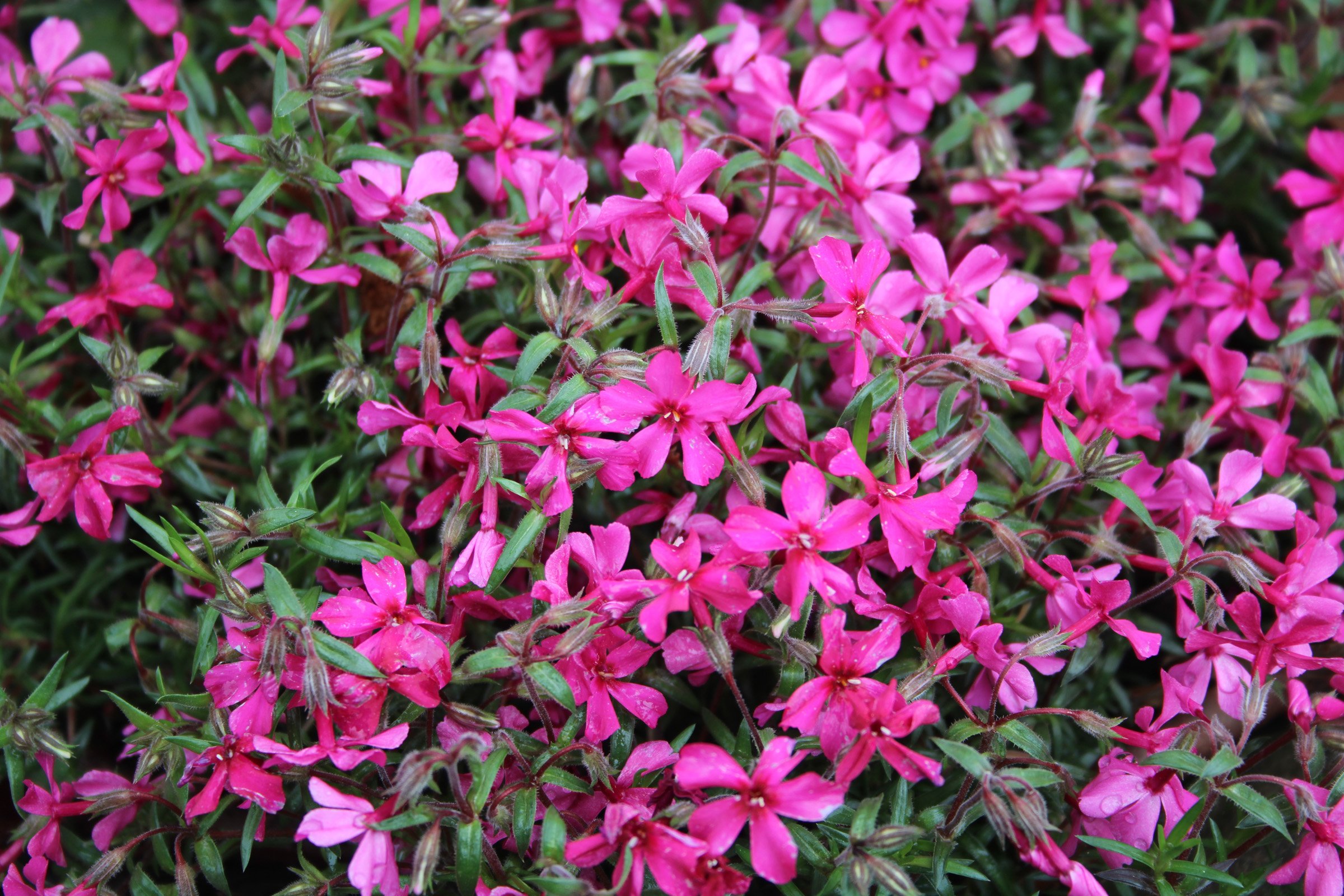
Phlox subulata is also known as Creeping Phlox, Moss Phlox, Rock Phlox, and Thrift. This evergreen perennial reaches only six inches tall, at most. It forms a tight mat of needle-like foliage that works well as a groundcover and is frequently used in combination with large rocks. The flowers are small (3/4 inch across, with five petals) but so numerous that they conceal the leaves, appearing like a blanket of color. Thrift is blooming right now in my area, with showy mats of pink, rose, white, light blue, or lavender flowers. It is often used on steep banks or slopes, where it will self-seed and spread to cover uneven terrain and prevent erosion. Give Thrift full sun or part sun in acidic soil. It requires little maintenance beyond a little thinning if it becomes so congested that it starts choking itself.

Phlox subulata is native to the US and will grow in zones 3-9. It is rarely bothered by insects or diseases. Deer do not normally browse Thrift; the flowers are favored by hummingbirds, bees, and butterflies.

I planted a couple of these Phlox subulata under a new redbud (Cercis chinensis ‘Don Egolf’) last year. The color of the flowers is a near-match to the color of the tree’s blooms. They flower at the same time, and are neighbors to a yellow Forsythia, which provides a nice color contrast.

This thick mat of Thrift (Phlox subulata) has spread to replace grasses or weeds that might have grown under this fence, eliminating hand-weeding or string-trimming.

Sassafras Signals Spring

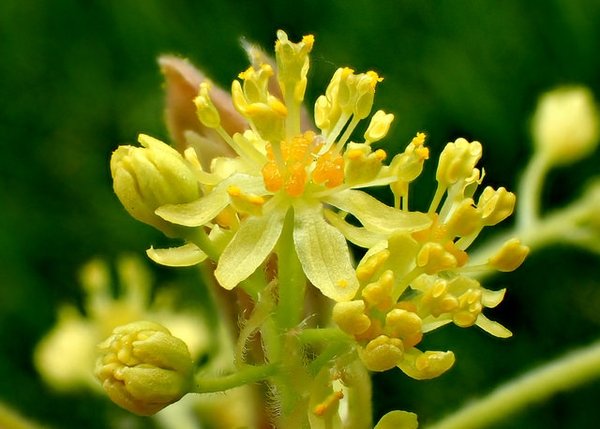
Spring’s arrival in evident in the woodlands: the reddish tint of maple trees, the yellow-green of new leaves on others. From a distance, I spotted a haze of yellow that I assumed to be flowering Carolina Jessamine, the SC state flower. But no, it was the early flowers of Sassafras, pronounced SAS-ah-fras.

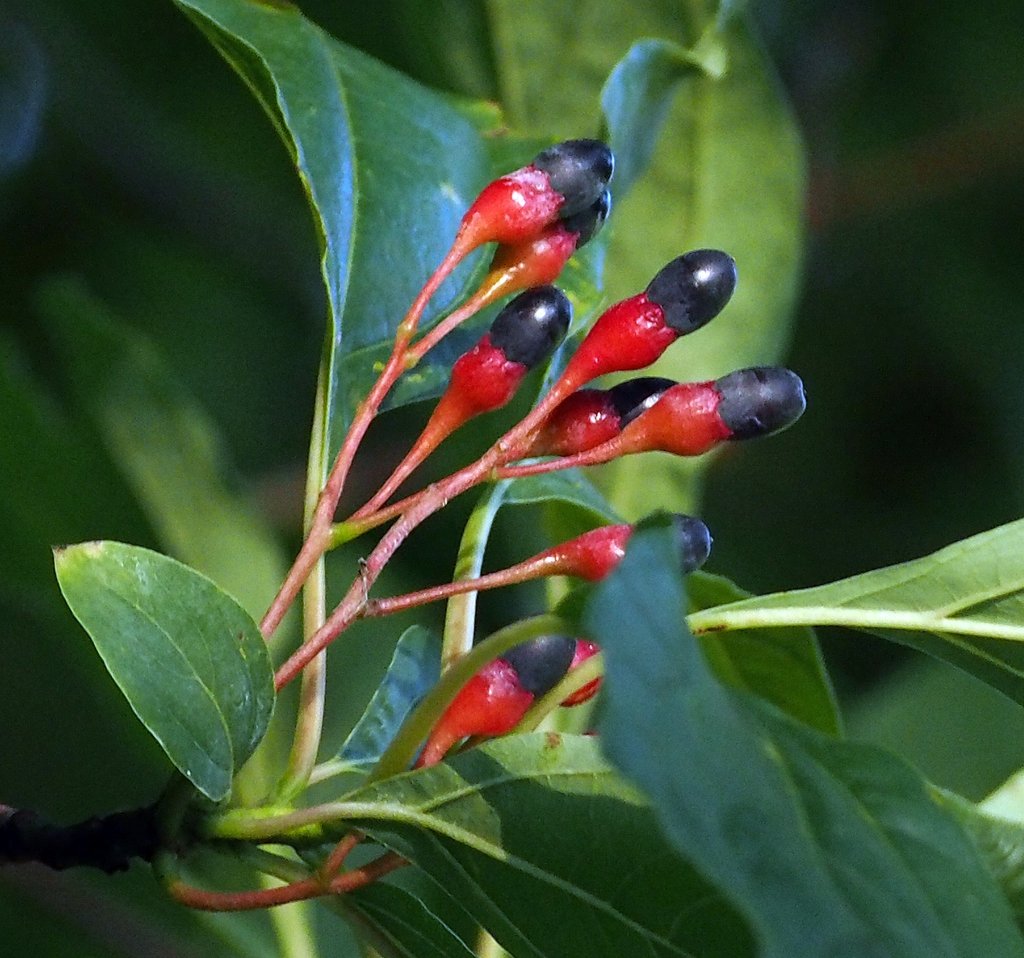
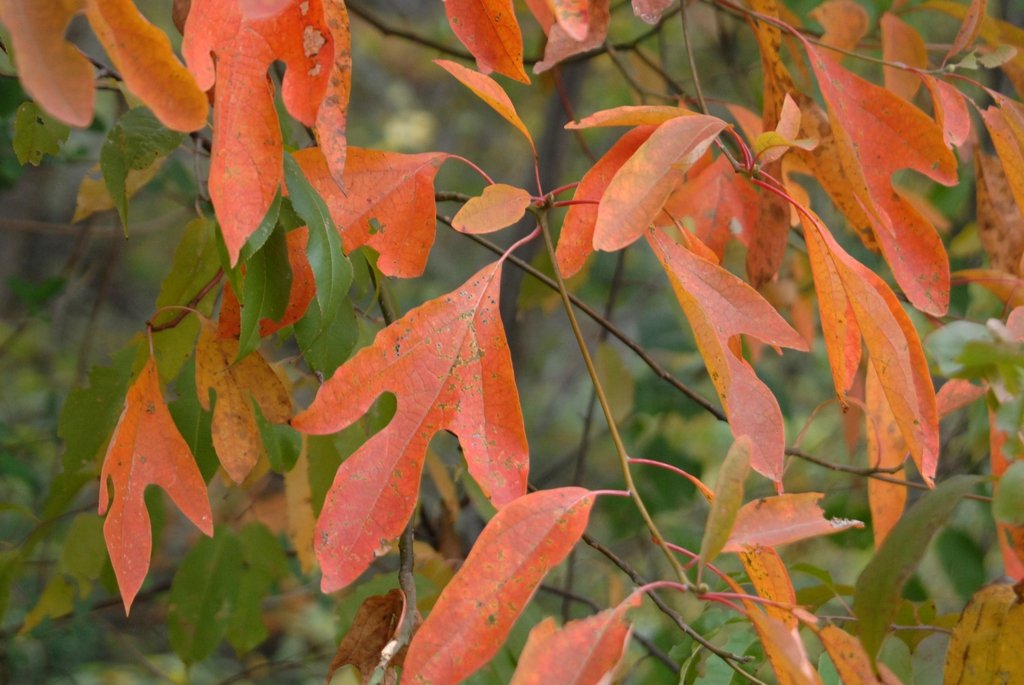
Sassafras is a deciduous native, found in more than half of the states, and is hardy in zones 4-9. It can be either a tree or a multi-stemmed shrub and will grow in neutral to acidic soil of almost any texture. It prefers full sun to partial sun. Flowers on female trees produce blue-black seeds held by red stems that are a favorite food of wildlife. Several species of swallowtail butterfly larvae feed on the leaves. Unfortunately, Japanese beetles eat them also. Fall leaf color is outstanding.

Established trees are heat and drought tolerant. Mature trees can reach to 60 feet tall and 40 feet wide. Trees can be pruned hard every other year to force multiple stem growth to create a hedge. Left alone, plants tend to sucker and may grow into a thicket naturally.

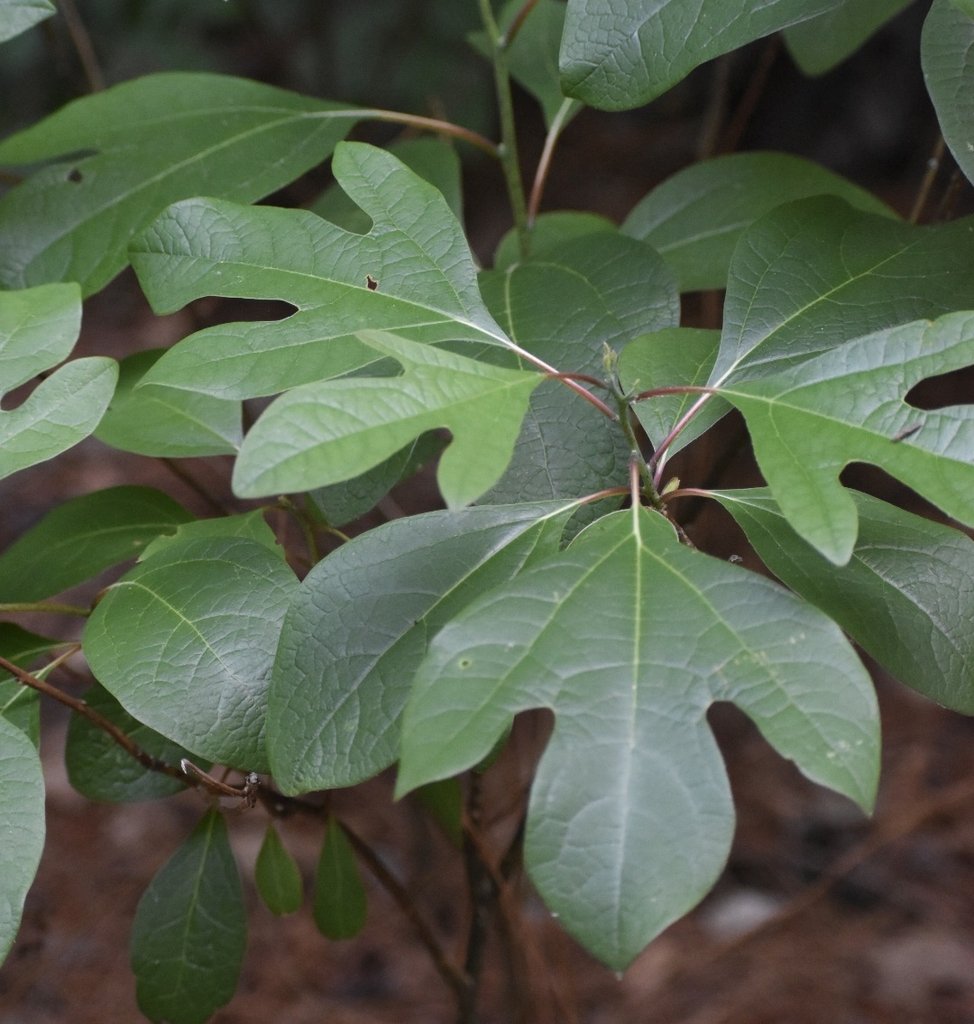
One of the most unusual facts about sassafras is that trees have three distinct leaf shapes, often occurring at the same time on a single plant. Leaves can be oval, mitten shaped (think of a palm with fingers held together and the thumb extended), or three-lobed (most common). Crushed leaves or injured bark exude a spicy scent. Native Americans used parts of the plants in medical treatments. Later, the roots were used to flavor root beer. That practice was discontinued when a cancer-causing compound was detected in the roots. You can still purchase filé, a thickening condiment made from powdered leaves, used in Cajun dishes like gumbo. The carcinogenic chemical concentration in filé is minimal.

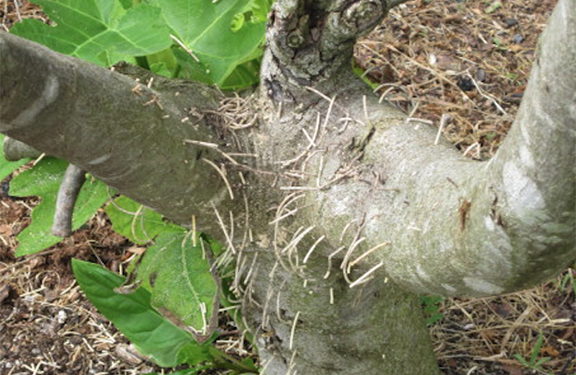
Sassafras plants have a deep taproot that make them difficult to transplant unless they are small. The growth rate is medium to rapid. Avoid boggy sites to lessen the chance of root rot. Sassafras is in the laurel family and suffers from some of the same issues – leaf spot, wilt – that plague other laurels. These issues are unlikely to damage the plant. Plants may be attacked by the Redbay Ambrosia Beetle, an insect known to spread laurel wilt. Ambrosia beetle is easy to detect. It makes the trunk look like toothpicks are stuck into the bark. If you see this issue on Sassafras or any other tree, contact your local Extension office for advice on treatment or removal.

Press Pause on Planting

I have no self-restraint when it comes to starting seeds indoors. Every year I begin too early and then I’m faced with seedlings that need to be planted outdoors or risk the danger of them becoming rootbound in their starter trays. I study the average temperature charts and review weather projections like a professional meteorologist. I transplant too early, and inevitably face a late frost. Then, I scurry around with row covers, old sheets, milk jugs, carboard boxes, and anything else I can find to protect my precious babies. Does this sound familiar to you?

Please, follow my advice and not my example. Seed packages provide the length of time before germination occurs. Find your last frost date and count backwards to the proper seed starting date for your area. My best results come when transplants have at least two pairs of leaves, not counting the cotyledons (“seed leaves”). Planting out a few days late is far better than planting out a few days too early. Cold-nipped tender plants take time to recover, so there is no gain from a head start.

Seeds have a specific temperature range for germination, so if you direct sow outdoors before the soil has warmed, they will sit until the temperature is right. In worst cases, they rot and die instead of sprouting. To learn the first frost and last frost dates for your zip code, visit https://garden.org/apps/frost-dates/ . To determine the soil temperature for your zip code visit https://www.greencastonline.com/tools/soil-temperature . The USDA Cold Hardiness Zones were updated in 2023 to reflect current data. My zone changed from 7b to 8a. To check the zone of your garden, visit https://planthardiness.ars.usda.gov/ .

While we think of 32 degrees as the magic point, frost can occur at temperatures below 36 degrees. A light breeze and high humidity help prevent frost formation. Cold air sinks, so garden beds located at the lowest part of your property may be a few degrees cooler than higher points. But gardening on a hilltop has its own challenges. For every 1,000 feet of elevation increase, temperatures drop 3 to 5 degrees below the average forecast. Gardens located near your house can benefit from the stored heat radiated by sun-heated buildings.

Frost is most likely to occur when skies are clear and temperatures fall in the afternoon. Clouds act like a blanket, retaining the sun’s heat near the surface. If you need to cover plants, get those sheets or whatever in place before sundown to maximize the amount of heat trapped. And don’t forget to remove them. One year I lost every tomato plant in my garden because I left glass quart jars over them while I rushed off to the office. Yes, they made it through a frosty night fine but then cooked to death when the sun came out and heated them through the glass. If only I had waited.

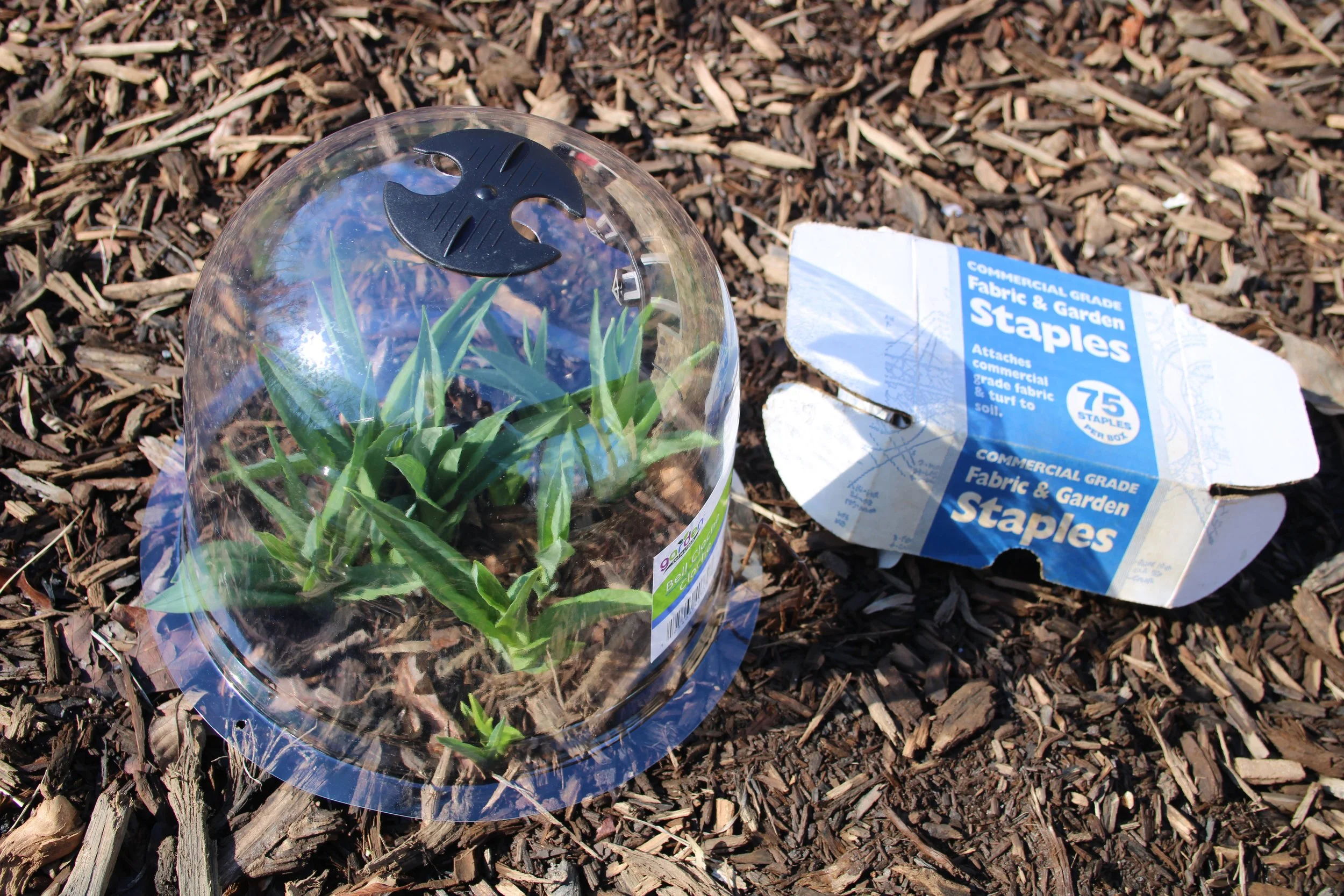
I found these clear plastic domes (“cloches”) at one of those stores where everything is $1.25. They have an adjustable air vent at top and pre-made holes around the bottom lip so they can be secured in place with a couple of landscape staples. Not as elegant as the classy glass ones, but easier to store and definitely cheaper.

In Search of the Rare Oconee Bell

Gardeners have a special affinity for rare plants like the Blue Poppy (Meconopsis) or the Franklin tree (Franklinia alatamaha). In March and April, plant enthusiasts travel for miles to Devils Fork State Park in Salem, SC to catch a glimpse of the rare, prized Oconee Bell plant in bloom. This wildflower occurs naturally in only seven counties in the US.

The Oconee Bell plant (Shortia galacifolia, pronounced SHORE-tee-uh guh-lay-sih-FOE-lee-uh) was discovered in 1788 by French botanist André Michaux. Unfortunately, he did not record the exact location of his discovery. Fifty years later, an American botanist named Asa Gray became obsessed with finding the plant in its native environment. He searched for 39 years without success until 1877, when a 17-year old boy who was helping his herbalist father collect specimens, saw the plant, could not identify it, and sent a specimen to a botanist in Rhode Island, who in turn sent it to Gray for identification. This sweet story illustrates a few points: (1) Always mark plant locations so you know where to find them. Use your mobile phone’s compass app to record GPS coordinates. (2) Force your teenagers to go into the woods with you. They bring a fresh set of eyes. (3) If you seek a special plant, don’t stop looking until you have found it.

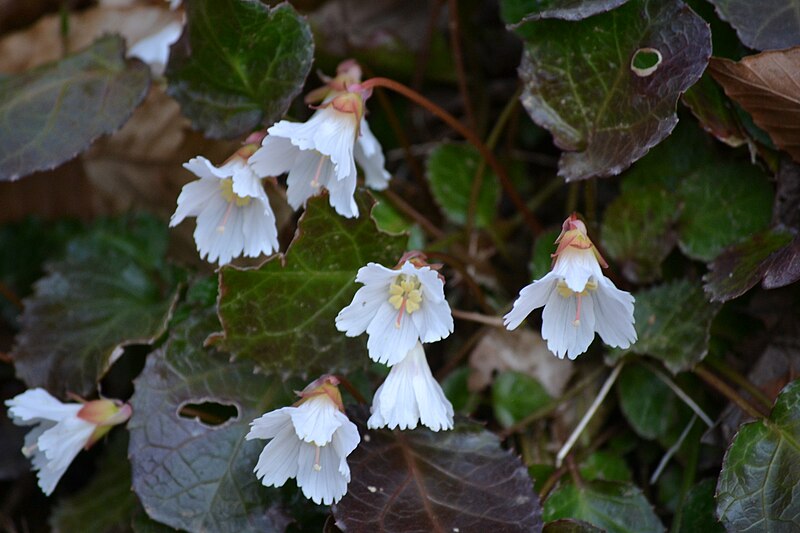
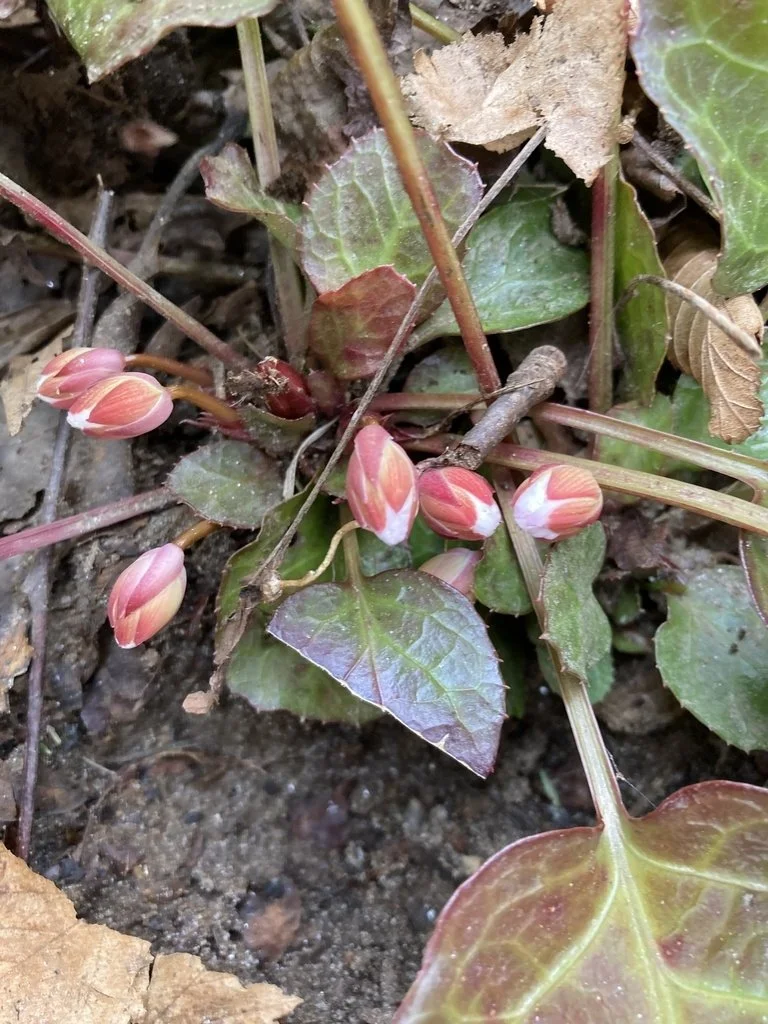
Oconee Bell grows in damp, partly shady areas, usually near a creek. It spreads by rhizomes and also by seeds. It can make a beautiful groundcover where the conditions are right. Small pinkish buds open to white  one-inch flowers with serrated petals that look as if someone trimmed them with pinking shears. The foliage is handsome when the plant is not in flower, and it turns a pretty shade of dark red in winter. Plants reach a maximum height of eight inches. They are normally found in areas that have been disturbed and are in regrowth. Once a tight overhead canopy establishes, the preferred environment no longer exists and plants make their way toward more favorable destinations.

These plants are considered endangered and should never be gathered in the wild. Professional botanists have planted seedlings in numerous places to avoid possible extinction. You can see them in spring in the NC Arboretum wildflower beds.

Oconee Bell in flower. Image by KudzuVine, CC BY-SA 3.0

Oconee Bell buds. Image by jackollis CC BY-NC 4.0

Oconee Bell showing the beginning of fall color. Leaves turn completely burgundy during winter. Image by David J. Stang, CC BY-SA 4.0

Trillium Means Spring

Signs of early spring are appearing everywhere. Crocus are flowering and early daffodils are in bloom where I live. Abelias are showing tiny leaves, buds are swelling on the Fothergillas, and maple trees are starting to show a red cast. One of my earliest spring indicators is the emergence of Sweet Little Betsy, Trillium cuneatum, pronounced TRIL-ee-um kew-nee-AH-tum. Other common names include Purple Toadshade, Wake Robin, and Bloody Butcher.

My Trillium originated with my husband’s grandmother, a remarkable gardener. My family enjoyed them for years when we lived at New Hope Farm. I dug the rhizomes and moved them to our new property three years ago. All internet gardening sites say that Trillium “do not transplant easily.” I carefully lifted a rootball about the size of a regulation basketball, and my plants never missed a beat. When our home renovation construction began near their location, I decided to divide the clump and keep some in a container in a site well away from backhoe and concrete trucks. This week, I am happy to report, I spotted healthy new growth and numerous buds on the rhizomes I potted as a precaution as well as those I left in the original location. The potted insurance plants will be relocated to a new, in-ground home during the coming week.

Sweet Little Betsy is native to the southeast. Plants have three mottled leaves and three petals, usually a deep wine red. Other species have white, yellow, and even pink flowers. They thrive in moist shade and enjoy the humus-rich soil of woodlands. Plants are winter-hardy in zones 5-8. They prefer an acidic to neutral soil.

You may have heard that one should never pick the flowers of a Trillium or it will die. I believed this until I researched this plant for today’s blog and found this folklore is total nonsense. If you pick the leaves, you may damage the plant by preventing it from generating food storage through photosynthesis, but you most likely won’t kill it. Trilliums are ephemeral, meaning they go dormant after they flower. Their food-making period is brief, so they need all their leaves to make the process efficient. Picking the flower may mean it won’t bloom in the coming year, but it will not kill the plant. So much for hearsay advice!

Trillium flowers smell bad (my opinion) but they produce early nectar for pollinators. Seeds are spread by ants. Plant reproduction via seeds is a slow process. It can take a year or two for seeds to germinate, and up to five years or even longer for new plants to flower. Division is much faster, but plants need a year or two to recover after separation. Lift plants carefully, as the rhizomes are brittle. The fleshy white roots are connected to the rhizome at a single point near the stem, technically, a “scape.” The trio of leaves immediately under the flowers aren’t really leaves, but “bracts.”

Some sites say that the leaves of young Trillium are edible, but other sites indicate they are mildly toxic and can sicken pets. Deer relish them without any bad effects.

nursery container of plant with mottled leaves and burgundy buds

Sweet Little Betsy, Trillium cuneatum, safely survived during our construction by moving to a container in our woodlands.

Tree of Heaven (NOT)

Look out, Bradford Pear tree. There is a new contender for the title of Worst Invasive Tree in the US. It is Tree of Heaven, Ailanthus altissima. Tree of Heaven (TOH) was introduced by a Pennsylvania gardener in 1784 as an ornamental. Native to China, it has spread like mad and is now found in 42 of the lower 48 states. TOH tolerates any type of soil, any moisture level, and any soil acidity. It grows in sun or shade. It produces hundreds of thousands of seeds annually. Within three months of seed germination, the tree has put down a taproot that helps it survive drought. It grows fast, up to heights of 80 feet, although 30 feet is more common. TOH has escaped cultivation and is displacing native trees in both urban and rural locations, the definition of invasive. Its roots damage plumbing pipes AND it serves as a host plant for the damaging spotted lanternfly. For additional information from NC State University, click HERE.

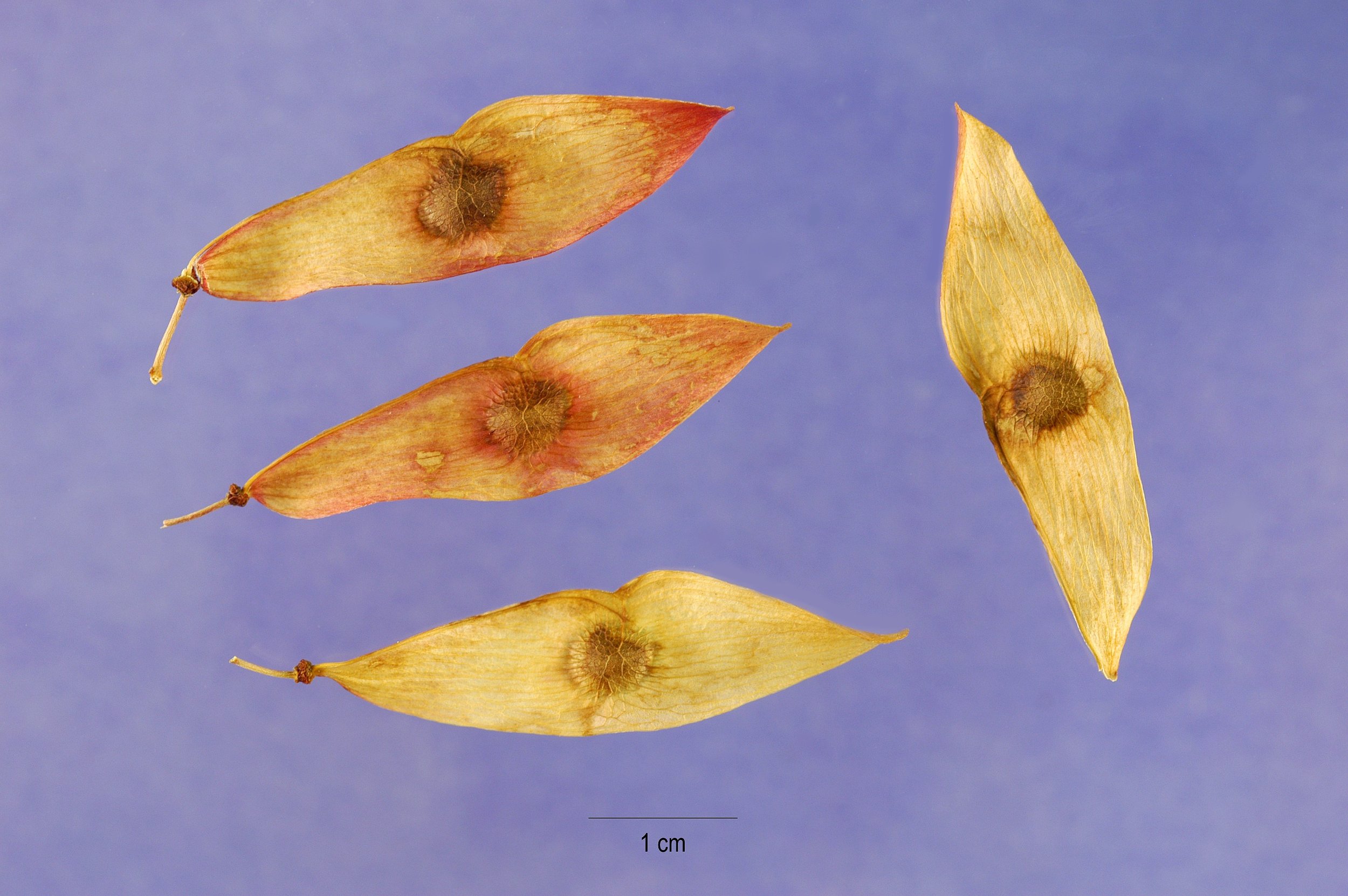
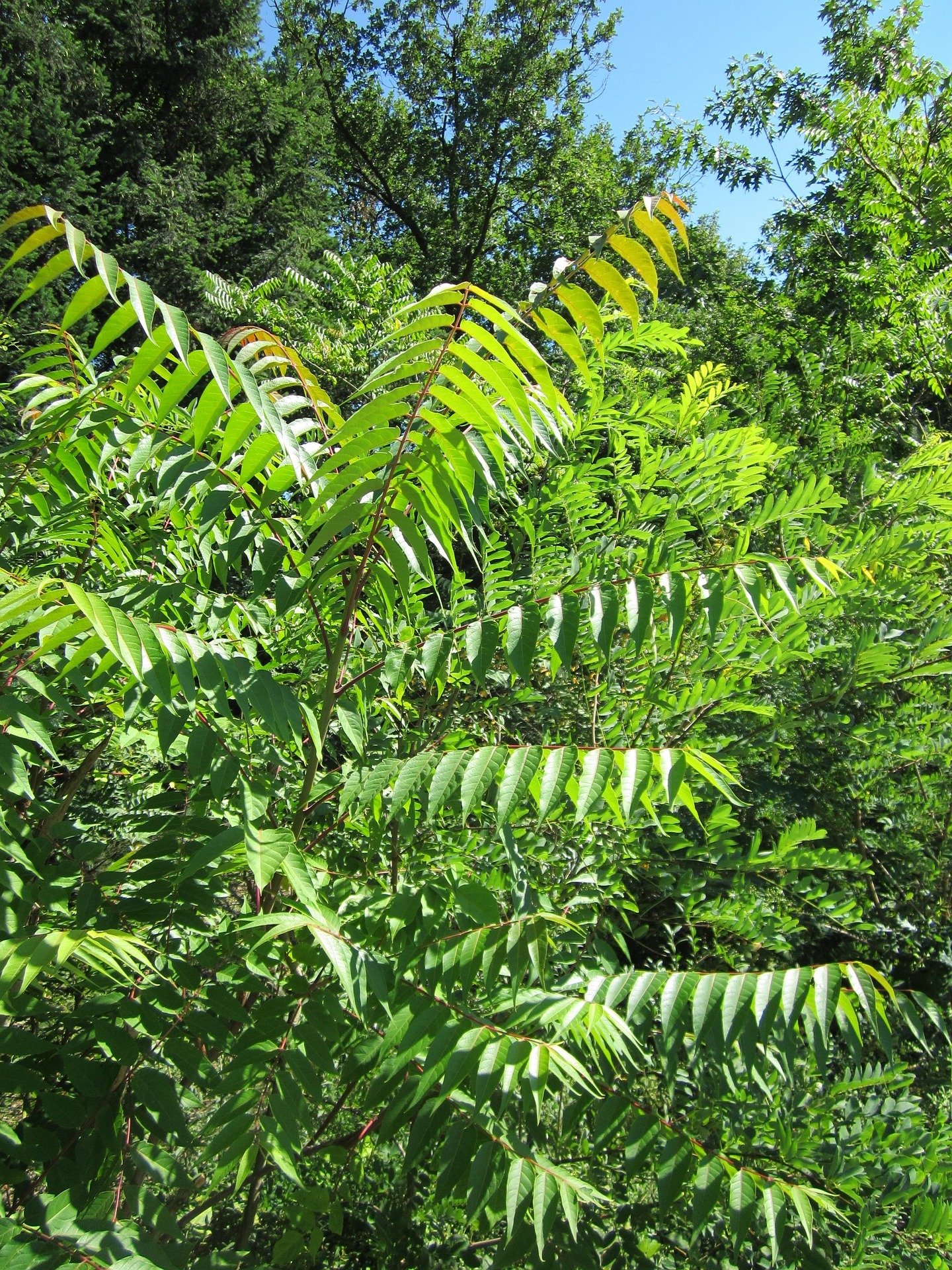
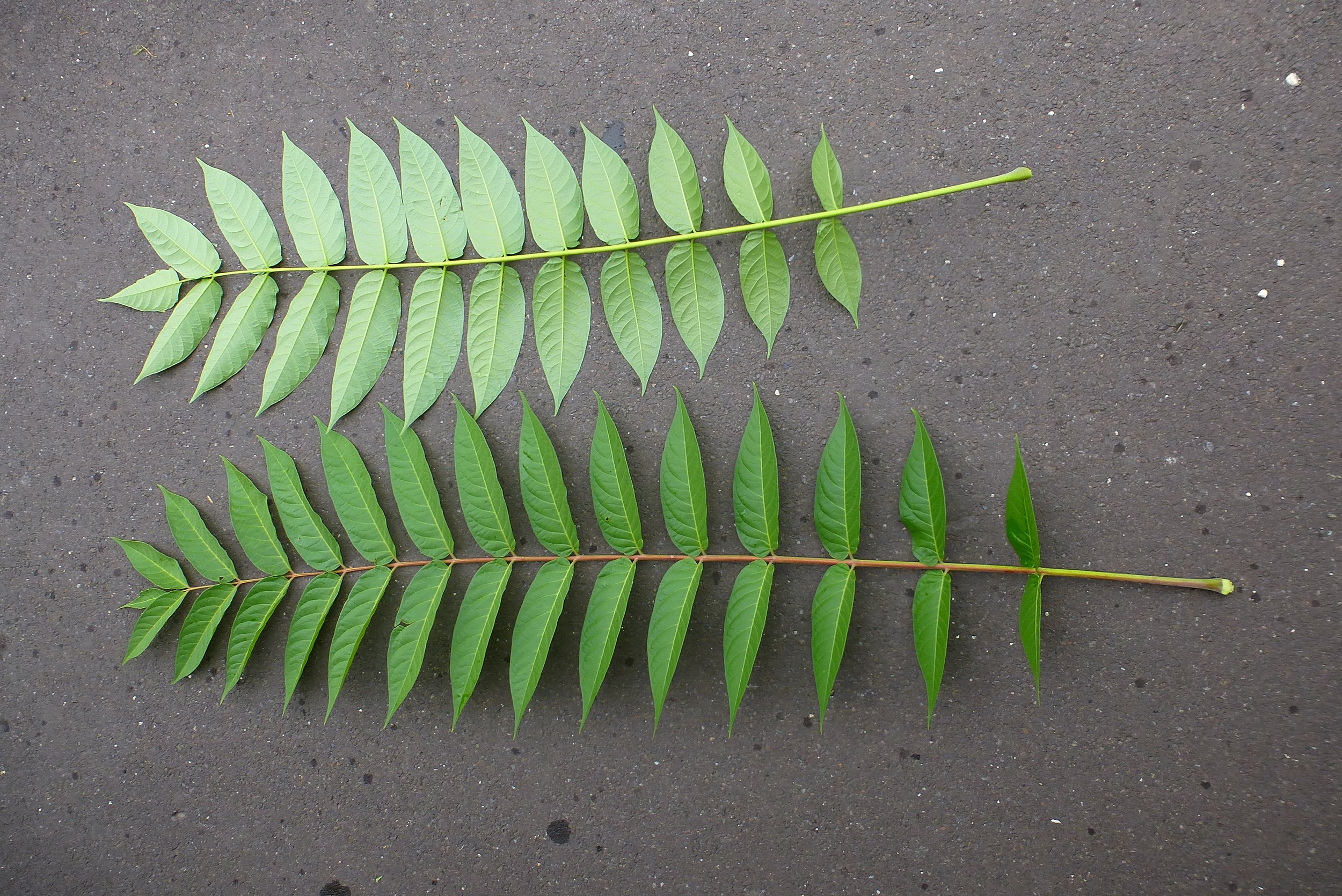
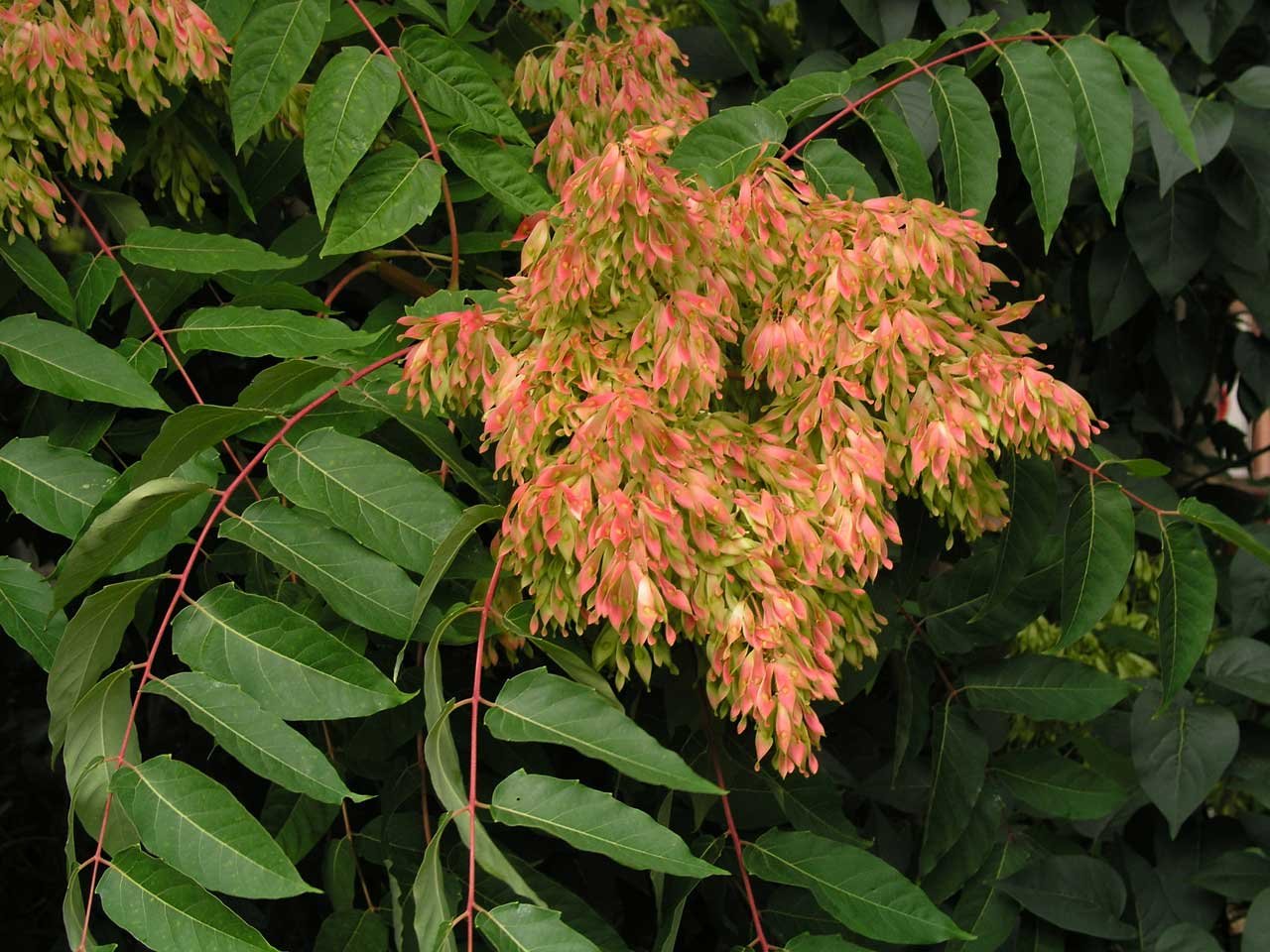
TOH leaves resemble sumac or black walnut leaves, with 10-40 leaflets arranged along a central stem that may reach up to four feet. Like black walnut (Juglans nigra), TOH exudes toxins that stunt surrounding plants that compete for moisture and nutrients. When crushed, the leaves smell bad. TOH flowers in middle to late summer, usually July to August. Flowers produce seeds in papery envelopes called samaras. Think of a maple tree’s helicopter seeds that have been pinched in the middle and you have a pretty accurate picture of what TOH seeds look like.

Not only does TOH spread with a vengeance, it is extremely difficult to control. It spreads by seeds and by root suckering — Little Shop of Horrors, indeed. Note: If you are opposed to herbicide use, stop reading now. Research is ongoing for biologic controls. If you merely cut down a tree without applying herbicide to the fresh cut, babies emerge from all the surrounding roots as well as from the trunk. If you try to remove a tree with machinery, any tiny portion of root left behind will spring into life as a new tree.
There are several recommendations for control. These methods include applications of herbicides glyphosate or triclopyr, and a satisfying-sounding method known as “hack-and-squirt.” Click HERE for detained instructions from the NC Forest Service. Remember to follow application instructions exactly. “The label is the law.”

Be aware of what is growing in and around your property. Any unwelcome invader is easiest removed when young. Eliminating the preferred food source will help control invasive spotted lanternfly. TOH control might save your plumbing, your driveway, and your surrounding woodlands. A widespread effort can prevent Tree Of Heaven from becoming the next kudzu or Bradford Pear.

Rosemary Is Now A Salvia

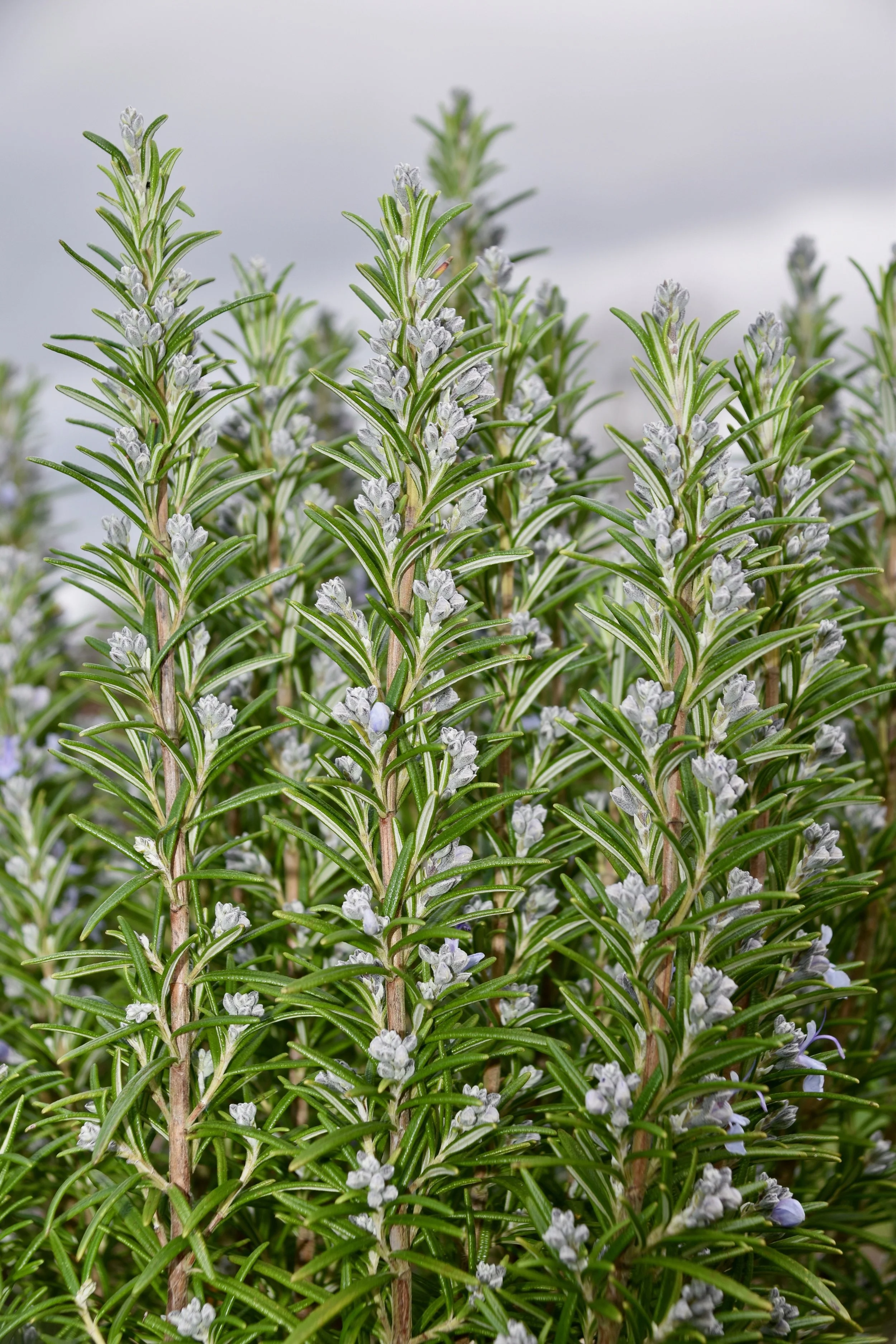
Here is another name update, for those of you who are interested in keeping up with taxonomy changes. Rosemary, formerly Rosmarinus officinalis, is now a Salvia, Salvia rosmarinus (pronounced SAL-vee-uh rose-ma-REE-nus). Rosemary is an aromatic evergreen shrub, often sold in 4-inch containers in garden centers. 

Rosemary is among my favorite herbs because of the wonderful resinous scent of the needle-like foliage, the flavor it imparts to food, low maintenance requirements, and deer resistance. The scent is not noticeable unless the leaves are disturbed. I trail a hand along the foliage whenever I pass it to release the fragrance. Sometimes I catch a delicious whiff when the sun shines directly on the plant and breezes are few. For delicious Italian bread or pizza crust, add chopped leaves (no stems) to your bread maker about half-way through its kneading process. Adding leaves too early can hamper the yeast action. A sprinkle of fresh leaves added to simple roasted potatoes elevates the dish from plain to gourmet.

Cultivars vary in form from upright to spreading. Most have tiny, light blue flowers in late spring, summer and early fall. Bees and butterflies visit the flowers, making them a good choice for pollinator gardens. Plants can be used in containers, as low hedges, or as groundcovers. Because deer generally avoid Rosemary, I have spaced plants around the garden, hoping they will work as horticultural security guards to protect my Hydrangeas and Gardenias from deer damage. There is not enough sun in the Hosta beds to keep Rosemary healthy, so I have not tried it in the shade beds, but I drop dried-out Rosemary stems from old flower arrangements in the Hosta area. It cannot hurt, right?

Years ago, I read that Rosemary was a good companion to hybrid tea roses, since it was reputed to repel aphids. I tested that theory and found that aphids like Rosemary, too. This is the only insect that has bothered it in the Snoddy garden, but others have mentioned problems with spider mites and mealybugs. I find it to be a low maintenance shrub. Plant it in a boggy soil, however, and you can kiss it goodbye. Plants require full sun and good drainage. Provide them with a loose soil of nearly neutral acidity. They even do well in rocky or sandy areas, and are resistant to damage from salt breezes.

Rosemary’s aromatic foliage makes it a good addition to winter cut flower arrangements. It is cold hardy in zones 8-10, and maybe even colder if grown in a protected location. In zones 7 and colder, grow Rosemary as an annual. It can be attempted as an indoor houseplant, but these usually fall prey to insect damage or overwatering.

Regular removal of stems for flavoring or cut arrangements serves to keep the plant compact and bushy, but with time Rosemary becomes woody and ugly. A severe pruning leaves an unattractive, stubby-looking plant, so when yours reaches that too-big stage, remove it and replace it with a new plant. Plants are best propagated from stem cuttings or layering. Seed starting is slow.

Of the cultivars, S. rosmarinus ‘Tuscan Blue’ is a fast grower. ‘Prostratus’ can be used as a groundcover or in a container, but will eventually reach heights up to two feet. ‘Arp’ is reputed to be more cold hardy than the others. S. rosmarinus ‘Officinalis’ is widely available. ‘Albus’ has white flowers and ‘Majorca’ has pinkish flowers but it is a stingy bloomer.

Remove Weeds While They are Young

Yesterday was one of those rare, glorious, warm days in the middle of winter. It is too early to start seeds or fertilize. Despite the calendar saying early February, I was able to work outdoors for hours without bundling up for a blizzard. And what did I do during those hours? Pulled weeds, of course.

 The recent warm days, the rains, and the slow lengthening of days have encouraged all those dormant nasties to spring to life. Weeds are tiny and the soil is damp, so they cannot resist a gentle tug. If you get rid of them now, you will be a happier gardener come May. By that time, roots are deeper and some plants have even dropped seeds and started to spread across lawns and flower borders.

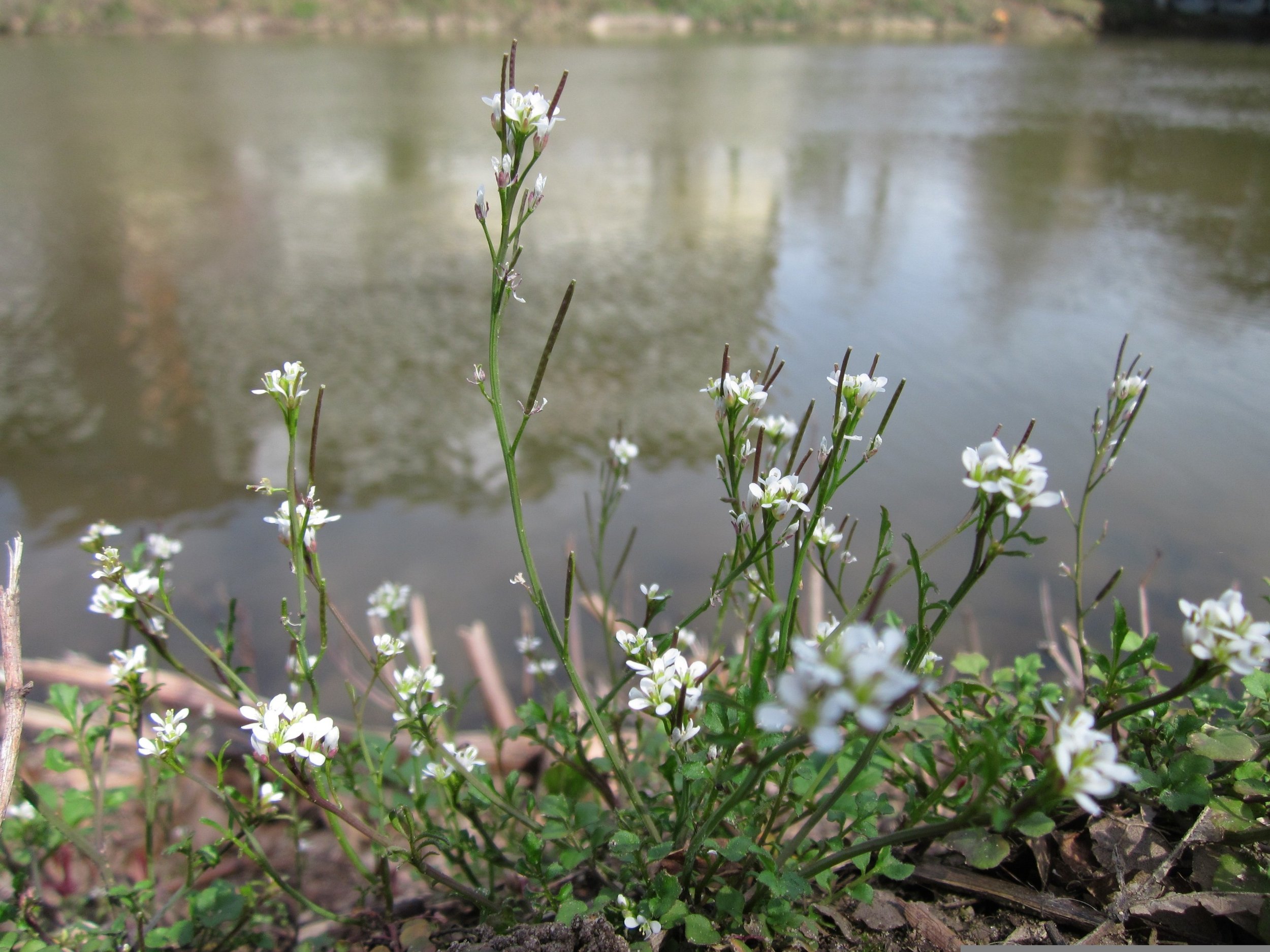
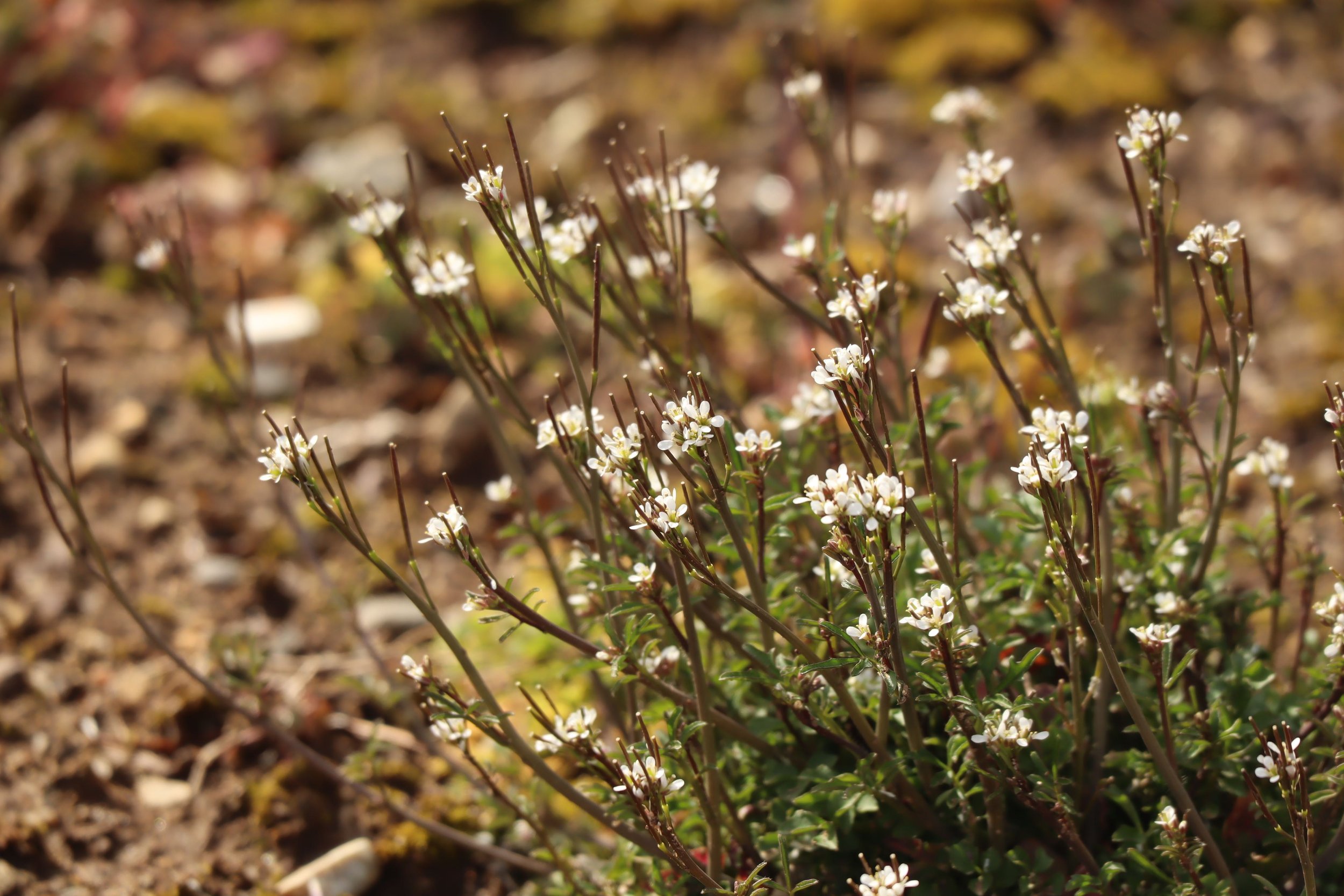
One offender that attempts to invade my space every year is Hairy Bittercress, Cardamine hirsuta. It is classified as a winter weed, but they pop up all year long in my zone 8 garden. These weeds are found in gardens across the eastern half of the US and in southwest Canada. They prefer moist, acidic soil but will grow virtually anywhere.
When I was enrolled in the Clemson University Extension Master Gardener education program more than twenty years ago, one of our instructors brought slides showing a greenhouse full of prepared seed flats. In one flat, a single Bittercress plant was allowed to bloom and go to seed. The lifecycle of Bittercress is reported to be 12 weeks. The timelapse photos indicated that one plant had turned into hundreds or maybe thousands in the greenhouse experiment, with all the surrounding flats showing baby Bittercresses. A single plant can produce 600-1,000 seeds and the germination rate is high. The seeds are held in long, skinny pods known as siliquas. When ripe, these pods eject their seeds up to several feet away from the mother plant. It does not take long for this invader to get out of control in the home garden. To prevent spread, maintain a healthy lawn with no bare patches, mulch garden beds, mow flowering plants before they set seed, and pull seedlings before they gain size and strength.

Yesterday, I removed Dandelion, Hairy Vetch, Chickweed, Henbit, Purple Deadnettle, Common Mallow, Purple Woodsorrel (creeping Oxalis), Common Plantain, Wild Garlic and several I know by sight but not by name. I’m keeping a vigilant eye open and weeding tool at the ready for emerging Mulberryweed (Fatoua villosa, easily the wickedest weed I’ve ever encountered), flat Prostrate Spurge, and prickly Horsenettle. I know they are out there.

A casual glance across beds and borders may not reveal the presence of these intruders while they are young and small. Once the knees are on the gardeners’ kneeling pad, they are more apparent. Use the occasional mild day to remove them now. You will be glad you did.

Using Animal Manure as Fertilizer

The calendar may say February and the forecast is for freezing temperatures, but that does not stop me from yearning to be outdoors in the garden. While it is too cold and too wet to garden, I have been reading about the use of animal manures as fertilizer. There is a lot to learn. Allow me to summarize a few important points.

Animal manure provides the big three – Nitrogen, Phosphorus, Potassium – as well as micronutrients. It is also a good source of organic matter, which improves soil structure. Horse, cow, sheep, and chicken manures are used in farming and gardening. They have different levels of nutrients. Because fresh manure potentially carries pathogens like E. coli, it should never be used on fruits and vegetables. Composted (heated and aged) manures do not share this danger. For flower beds and lawns, fresh manure can be used but should be tilled into the top six inches of the soil within hours of application so that the nitrogen does not dissipate into the atmosphere.

Chicken manure, especially, will harm or kill plants if it is used fresh from the hen house in large quantities. It is considered a “hot” manure, containing a lot of ammonia. Horse manure is typically loaded with grass and weed seeds. Unless it is composted before use, those seeds will germinate in the garden. The downside of composting manure is that aging allows some of the valuable nitrogen to leach out into the air. Cat, dog, and pig manures are never used since they can carry pathogens that survive heat and aging. My favorite manure (is it weird that I have a favorite?) is composted rabbit manure. I am searching for a new source, since the rabbit farmer from my past has retired. Rabbits produce manure in neat little pellets that spread easily. My peonies put on an amazing performance when sprinkled with rabbit doo, that I have not been able to replicate with any other product, organic or chemical.

The contents in bags of “composted manure” that we buy at garden centers have been heated and aged so that any weed seeds are killed and there is no odor. Because the moisture is mostly gone, it is light in weight and easy to spread. Approximately 75% of phosphorus and 85% of potassium are still available in manure that has been aged for a year, but nitrogen content is much lower than fresh manure, so it is best to consider these products as a means of adding organic matter. The mild nutrient addition is just a bonus.

As always, the best way to know what your garden needs is to have a soil analysis. Don’t guess – soil test. There is still time to submit a soil sample to your Extension office and receive results before spring planting commences.

For interesting reading, follow this link to read How Animal Manure Could Help Reduce Agriculture’s Carbon Footprint by Emma Stuck, a 2020 article published by NC State University College of Natural Resources: https://cnr.ncsu.edu/news/2020/11/how-animal-manure-could-help-reduce-agricultures-carbon-footprint/

Pachysandra as Evergreen Groundcover

One of my former neighbors persisted in trying to grow Pachysandra as a groundcover under his oak trees. Tray after tray of plugs arrived and were planted in spring, only to die by fall. He finally relinquished his preferred plan and planted variegated Bishop’s Weed (Aegopodium podagraria) instead. Also called Goutweed, Snow On The Mountain, or Ground Elder, Bishop’s Weed is an aggressive, invasive groundcover that is difficult to eradicate once established. I suggest you avoid it.  Given the neighbor’s difficulty in growing Pachysandra, imagine my surprise last year when I stumbled across a large (forty feet by seventy feet) patch of it growing on a woodland bank near my creek. In May, it looked like a large emerald blanket, and even draped over the creek bank like a curtain. This week, it shows the ravages of extreme cold and too much rain, but it is still an effective groundcover. I have no doubt that it will return to its former glory when temperatures warm in spring.

 There are two species of Pachysandra. Allegheny Spurge (Pachysandra procumbens, pronounced pak-ih-SAN-drah pro-KUM-benz) is native to the southeast. It is evergreen to semi-evergreen, and cold hardy in zones 7-8. It grows in rich, moist, acidic soil, in dappled shade to full shade. It is not invasive. This is the variety that is living happily in my woodlands. It averages nine inches tall and has not been browsed by deer, despite heavy populations in this area.

 Like other plants we have adopted from the Land of the Rising Sun, Japanese Pachysandra (Pachysandra terminalis, pronounced pak-ih-SAN-drah ter-min-AL-iss) tolerates a wide range of temperatures (zones 5b-9a) and is a more aggressive grower than the native type. It may grow up to a foot tall but is typically shorter, and spreads by underground rhizomes. ‘Green Sheen’ is especially heat tolerant. ‘Green Carpet’ is a mounded uniform form that lends itself to edging for shady beds.

 Both the above species bloom in spring, but the flowers are not particularly eye-catching. Bees love them. Pachysandra is in the same family as Boxwood and shares some of its susceptibility to scale, leaf spots, and root rot. Don’t overwater, and if dead or diseases patches become apparent, remove them before the problem spreads to the rest of the bed.

Big box stores usually sell Pachysandra in trays of 2-inch plugs. Tease them apart carefully to avoid damaging tender roots. Place plugs six inches apart for rapid coverage, or up to a foot apart. Even at the wider spacing, ground coverage should be complete in three years. when grown in moist shade and fertile soil. Be careful to avoid constantly wet soils.

Warm Yarrow to Brighten a Cold Day

The US is blanketed by cold weather this week. My Camellia japonica was covered with flowers. Now they are blackened and sad. I visited my photo files to find something to make me remember the warmth of summer, and ran across pictures of Yarrow.

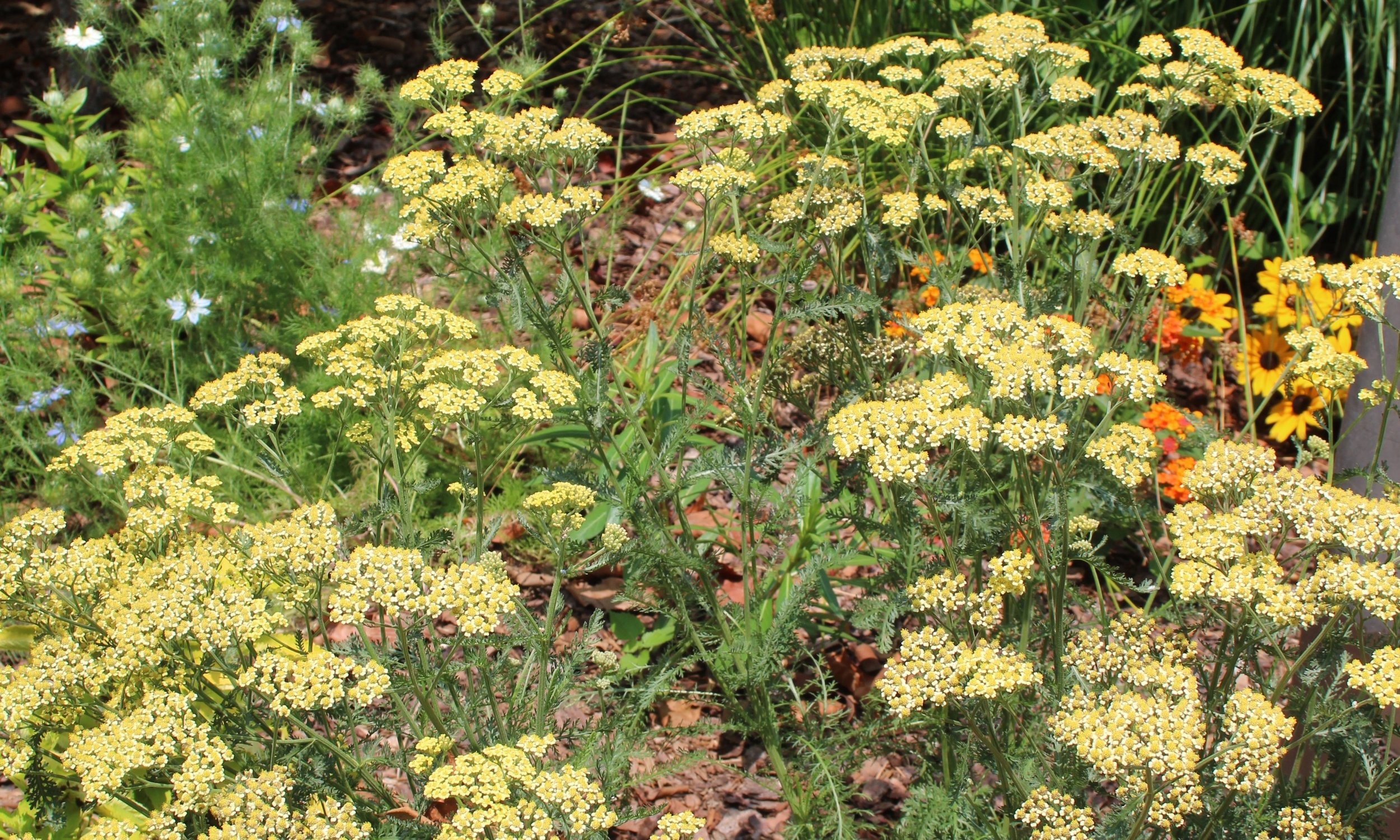
Yellow Yarrow is a heat tolerant plant beloved by pollinators.

Achillea millefolium (ack-uh-LEE-ah mill-ee-FOH-lee-um), commonly known as Yarrow, is an easily grown, heat-tolerant perennial for full sun. It has finely divided grayish foliage. Almost leafless stems terminate in flat-topped clusters of many (20 to 25, on average) small blooms. The straight species can become weedy or invasive, but the hybrids sold in garden centers are mostly sterile. Flowers come in pastels, yellow, white, red, purple, and orange shades. Yellow is the most common color and it ages well. ‘Moonshine’ has lemon-yellow flowers.

Yarrow has a long bloom period, from summer to frost. Plants can be deadheaded to encourage more flowering. If they become messy or foliage begins to brown or look tattered, an aggressive cutback will spur new growth. Yarrow likes a neutral pH and well-drained soil. While easy to grow in loam or sand, clay soils should be amended with organic matter to increase drainage and avoid excessive moisture that may lead to root rot.

Yarrow is a great plant for pollinator gardens, xeric gardens, and evening gardens, where the gray foliage remains visible at dusk. It mixes and mingles well with other plants, and can be sprinkled among cottage garden beds as a see-through plant. Deer avoid them.

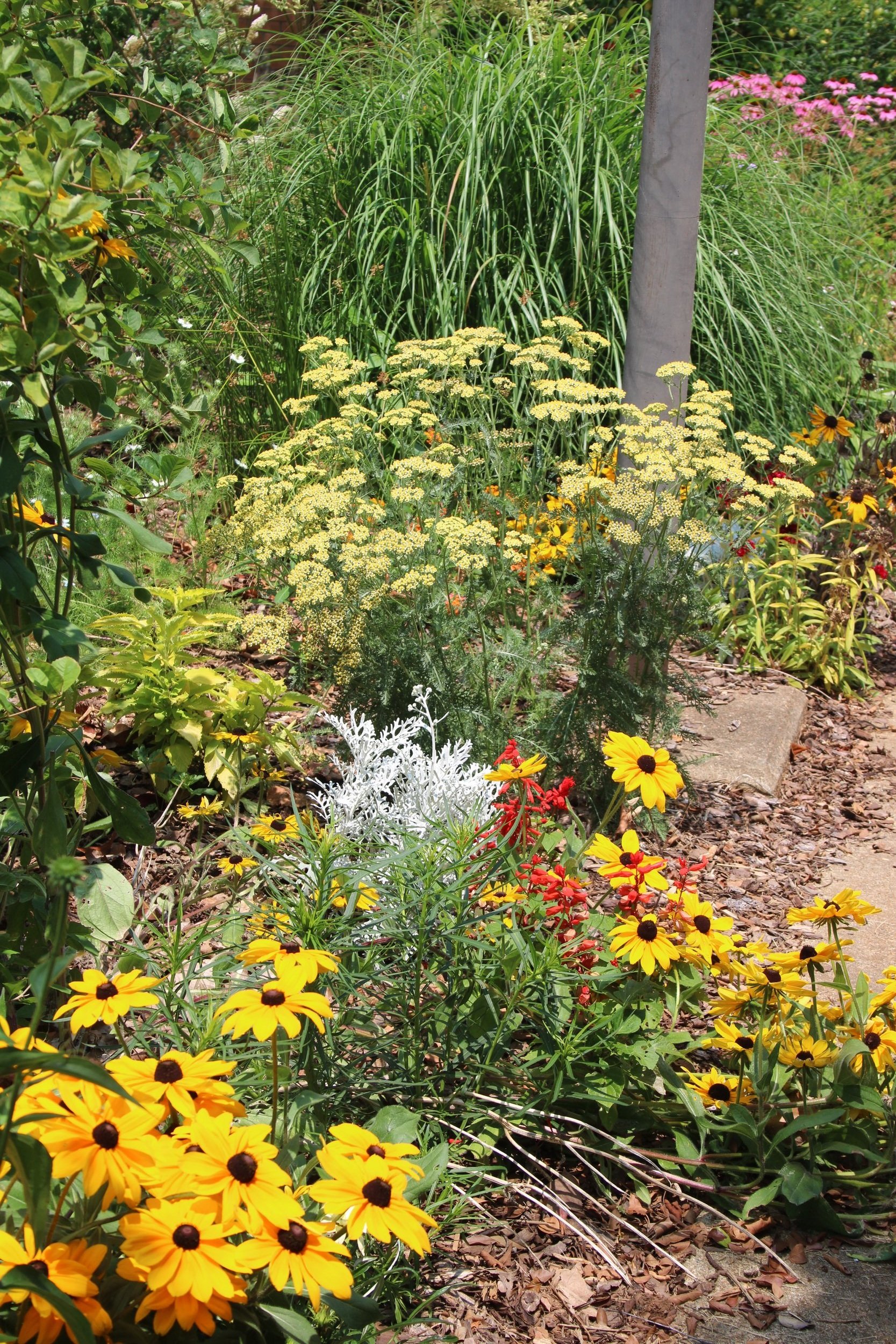
This photo was taken in mid-June of last year, in the botanical gardens of Spartanburg Community College. The fine flowers of pale yellow Yarrow pair nicely with the bold flowers of Rudbeckia and the red accent of Salvia. A gray Artemisia provides contrast, like a condiment adding spice to a bland meal.